
A Scenery Project Chosen by the Community
New Orleans Lakefront Airport was not selected during an internal development meeting. Propair Flight says the idea came directly from its flight-simulation community.
Users nominated the airport, voted for it and ultimately helped determine which destination the developer would build next. Propair then combined that community request with professional aviation knowledge and scenery-development experience to create the finished product.
“Our goal is not simply to reproduce an airport,” the Propair Flight team said. “We want to understand what makes a place interesting to aviators and then translate that into a digital experience.”
For KNEW, the airport’s unusual waterfront setting and substantial aviation history provided plenty of material.
Detailed Recreation for Both Microsoft Simulators
The new scenery was developed for Microsoft Flight Simulator 2020 and Microsoft Flight Simulator 2024, allowing pilots using either generation of the platform to visit Lakefront Airport.
The package includes:
- Native compatibility with MSFS 2020 and MSFS 2024
- Detailed custom 3D buildings
- High-resolution PBR materials and textures
- A custom airport ground polygon
- Multiple parking areas supporting AI traffic
- Realistic nighttime lighting
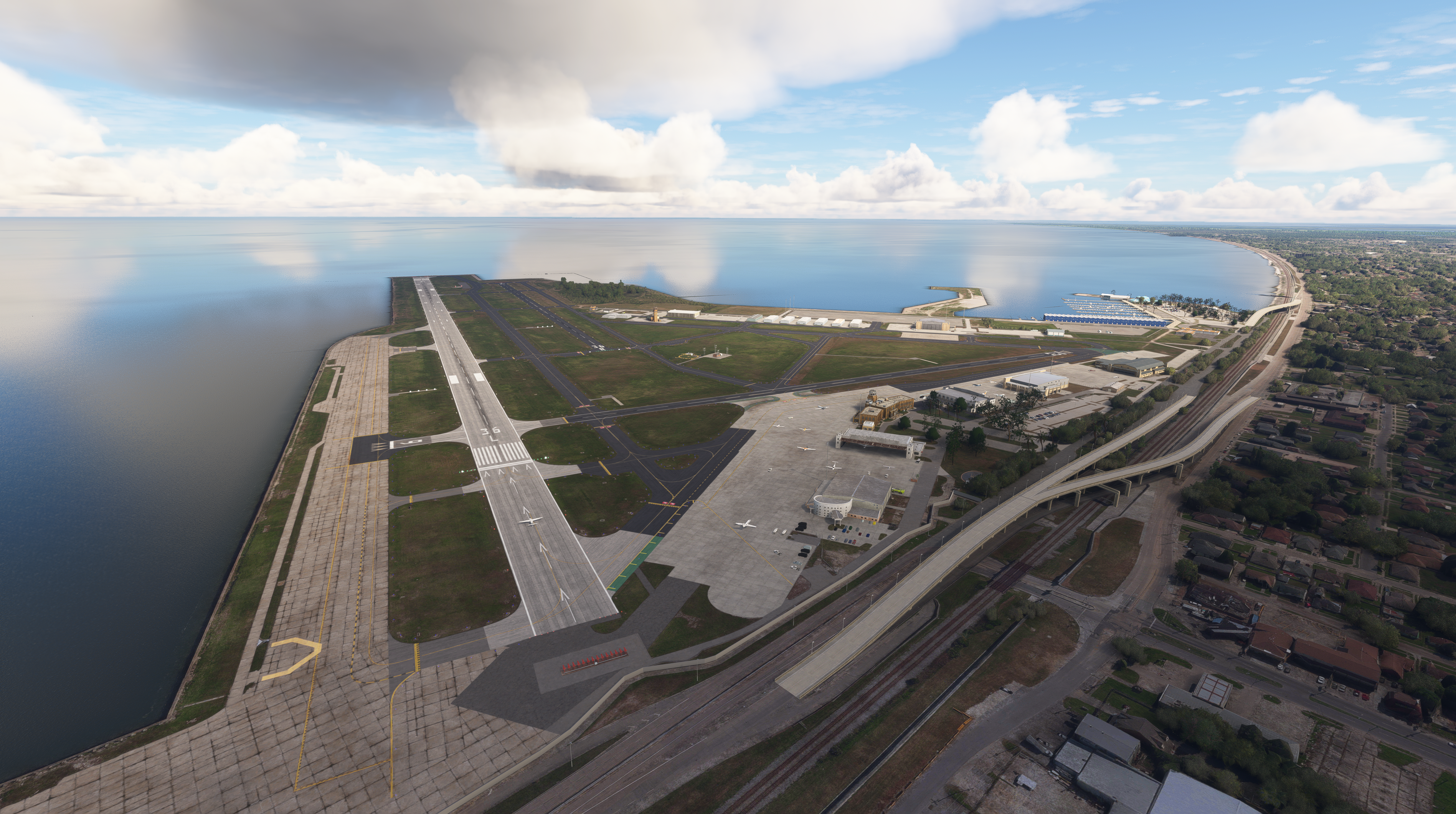
The airport’s location on a man-made peninsula extending into Lake Pontchartrain should make it a particularly recognizable destination from the air. Its proximity to downtown New Orleans also makes KNEW a suitable starting point for local sightseeing flights, general-aviation operations, charter flights and regional trips along the Gulf Coast.
Readers can find additional releases in Sky Blue Radio’s scenery news and coverage and follow the latest Microsoft Flight Simulator 2024 developments.
An Airport Built During Aviation’s Golden Age
New Orleans Lakefront Airport opened in February 1934 as Shushan Airport. It was constructed on an artificial peninsula created using millions of cubic yards of fill pumped into Lake Pontchartrain.
The airport was dedicated as the “Air Hub of the Americas” and was promoted as the world’s first combined land-and-seaplane airport. Its ambitious facilities reflected the confidence and excitement surrounding aviation during the 1930s.
Lakefront’s Art Deco terminal included elaborate stonework, murals and decorative architectural features. The airport also offered amenities that were remarkably sophisticated for the period, including a swimming pool, tennis courts, a post office, medical facilities and rooms where travelers could stay overnight.
One of those visitors was Amelia Earhart, who stopped at the airport in 1937 during the journey that would become her final flight.
The airport’s commercial role declined after Moisant Field—now Louis Armstrong New Orleans International Airport—opened and became the city’s primary airline facility. Lakefront Airport adapted by focusing on general aviation, corporate aircraft, charter operations and flight training.
From Cold War Shelter to Katrina Restoration
Lakefront Airport’s terminal underwent a dramatic transformation during the Cold War. Concrete, plaster and metal panels were installed around the Art Deco building as it was converted into a nuclear fallout shelter.
Those alterations covered many of the terminal’s original architectural details for decades.
Hurricane Katrina delivered another major blow in August 2005. Storm-surge flooding placed approximately eight feet of water around the airport and four feet inside the historic terminal. Flight operations eventually resumed, but repairing the terminal required an extensive restoration effort.
Work beginning in 2008 removed later modifications and uncovered many of the building’s original Art Deco features. The restored terminal was rededicated in 2013.
Today, the airport serves private, corporate, charter, military and general-aviation traffic while preserving what its official history describes as a living example of New Orleans aviation heritage.
Lakefront Airport Available Now
Propair Flight’s KNEW scenery is now available through the developer’s official online store and participating third-party retailers.
The release provides flight-simulation pilots with more than another place to land. It recreates an airport that has survived changing aviation markets, Cold War modifications and one of the most destructive hurricanes in American history.
With its waterfront approaches, distinctive terminal and downtown New Orleans nearby, Lakefront Airport offers plenty of character for pilots looking to add another historic destination to their Microsoft Flight Simulator collection.