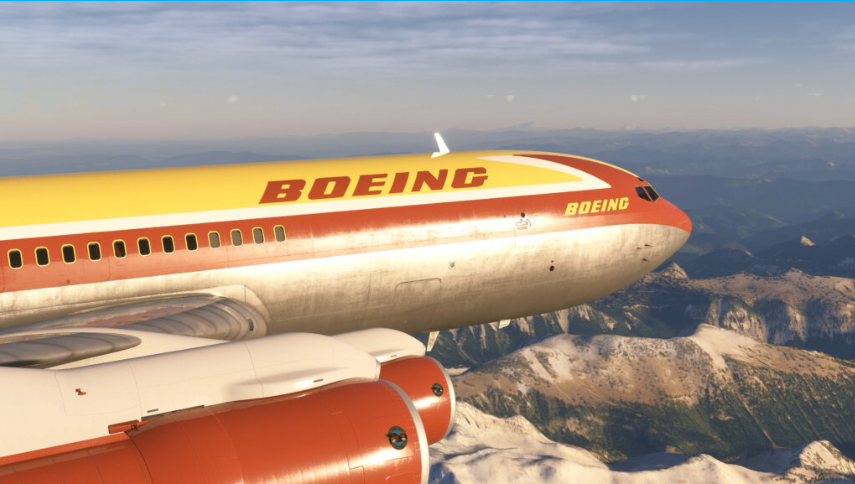


The aircraft was released on August 11, 2026, and is available now through the in-sim Marketplace for $14.99. It was developed jointly by iniBuilds and Working Title for Microsoft Flight Simulator.
A Jet That Helped Define Modern Air Travel
The Boeing 707 holds a special place in commercial aviation history.
The aircraft grew out of Boeing’s privately funded 367-80, better known as the “Dash 80,” which first flew in 1954. That demonstrator ultimately led to the Boeing 707 family and helped establish the design language that would define Boeing jetliners for decades.
The first production 707-120 entered airline service with Pan American Airways in 1958, helping usher in a new era of long-range jet travel.
Microsoft’s Famous Flyer release focuses on the 707-320C, the convertible passenger-and-freight variant introduced in the early 1960s.
The “C” stood for convertible, allowing airlines to configure the aircraft for passengers, cargo or a combination of both. Its most obvious external difference from earlier 707 variants was the large main-deck cargo door.
Microsoft says 337 examples of the 707-320C were produced, making it the most numerous version of the 707 family.
Three Different Ways to Navigate
One of the most interesting parts of the new aircraft is the ability to choose between three historically plausible cockpit navigation configurations.
Pilots can fly with:
- Carousel IV-A inertial navigation system
- UNS-1 flight management system
- Garmin GNS 530
That means the same aircraft can be flown as a period-correct classic airliner or with navigation equipment reflecting upgrades fitted during the 707’s unusually long operational life.
For pilots who want the full vintage experience, the Carousel IV-A INS is simulated from alignment through waypoint sequencing and position drift.
The physical system could store only nine waypoints at a time, forcing crews on long flights to continuously update the unit as the journey progressed.
Microsoft has recreated that limitation, while also providing a Virtual Navigator that can automatically feed route information into the INS for pilots who would rather spend less of the Atlantic crossing typing coordinates.
Alignment can be set to realistic, fast or instant, and inertial drift can also be disabled for a simpler experience.
A Virtual Flight Engineer Joins the Crew
The real Boeing 707 required a three-person flight crew, and Microsoft has addressed that additional workload with a Virtual Flight Engineer.
The VFE can assist with guided flows, cockpit preparation, system operation and shutdown procedures.
It can also manage functions such as pressurization and fuel-tank switching during flight.
The automation is designed to remain visible rather than silently moving switches in the background.
Knobs turn, switches move and checklist items are called as the virtual crew member performs tasks.
Pilots can still choose how much help they want, allowing the 707 to range from a demanding multi-crew simulation to something much more approachable for a solo simmer.
Adjustable Realism
Microsoft has included a number of options designed to let pilots decide just how historically accurate they want the experience to be.
The altitude selector, for example, can behave like the original alerter or act as a modern preselector capable of allowing the autopilot to capture a selected altitude.
The chronometer can be simplified or fully simulated.
Yes, fully simulated means the clock actually needs to be wound.
One winding lasts eight days.
Forget, and the 707 will eventually remind you that rechargeable cockpit clocks were apparently too luxurious for the 1950s.
Other options include modernized HSI behavior, simplified parking-brake operation, SID and STAR importing for the INS, automated fuel balancing and automatic cabin-window shade management.
Deep Pneumatic and Environmental Systems
The 707 includes detailed pneumatic and environmental control systems rather than treating bleed air and cabin conditioning as background decoration.
Microsoft says the simulation includes:
- Engine bleed air
- APU bleed air
- Turbo compressors
- Pneumatic ducting
- Air-conditioning packs
- Coolant air systems
- Cabin pressurization
- Outflow valve operation
The pressurization system models cabin altitude, landing mode and the associated cockpit controls.
The electrical system also includes multiple generators, external power, batteries, APU generation, bus-tie logic and essential-power distribution.
Authentic 707 Flight Controls
The 707 used a fascinating flight-control arrangement very different from modern fly-by-wire aircraft.
Its elevators and ailerons were aerodynamically driven.
The pilot moved control tabs, and airflow then moved the larger control surfaces.
Microsoft says that behavior has been reproduced in the new model.
Park the aircraft and move the controls, and only the tabs should move.
Take the aircraft into the air and the aerodynamic forces begin doing the rest of the work.
That is the kind of wonderfully mechanical detail that makes an older aircraft feel fundamentally different from flying a modern airliner.
A Complete Convertible Interior
Because the -320C was designed to move passengers, cargo or both, the Famous Flyer includes a modeled combi configuration.
The main deck includes a cargo section behind the cockpit and a passenger cabin farther aft.
The aircraft also includes:
- Operable main cargo door
- Visible cargo containers
- Forward and aft galleys
- Lavatories with opening doors
- Passenger cabin
- Working cabin lights
- Adjustable window shades
- Courier and cargo-master seating
- Lower baggage compartments
- Rear boarding stairs
- Ground service equipment
Microsoft even notes that the galley service door is modeled at its true airline-cart size, meaning taller virtual humans may need to duck.
JT3D Engines and Water Injection
The aircraft is powered by four Pratt & Whitney JT3D low-bypass turbofan engines.
Microsoft has modeled details including the engine inlet guide vanes and the distinctive blow-in doors surrounding the inlet.
One of the most entertaining additions is an optional water injection system representing the JT3D-3B.
Water injection was used to recover thrust during hot-weather or high-elevation takeoffs.
The simulated system affects engine thrust and EPR, and the water supply is finite.
Microsoft has even reproduced the black smoke associated with a wet takeoff.
So if your departure looks like a coal-fired power station briefly achieved rotation speed, there may actually be a historical explanation.
Vintage Weather Radar
The aircraft includes a simulated Bendix RDR-1 weather radar, one of the early radar systems used by airliners.
Rather than the modern multicolor displays familiar to present-day crews, the simulated unit uses a green display with precipitation appearing in white.
Radar tilt is functional, and Microsoft describes it as one of the first aircraft in MSFS to simulate that functionality in this fashion.
Custom Autopilot
The 707 also includes a period-appropriate custom autopilot and flight-director system.
Available modes include:
- Heading
- Navigation
- Approach
- Altitude hold
- Navigator-coupled operation
The key distinction is that the system is intended to behave like the original aircraft rather than giving the 707 modern automation it never had.
The aircraft also simulates directional gyro behavior, including earth-rate drift, transport drift, synchronization and magnetic-following modes.
EFB Support Without Turning the 707 Into a Tablet
Despite its vintage cockpit, the new Famous Flyer integrates with the Microsoft Flight Simulator 2024 EFB ecosystem.
A dedicated companion application provides:
- Aircraft configuration
- Door controls
- Performance calculations
- INS support
- Operational utilities
Takeoff and landing performance calculations include V-speeds, stabilizer trim, runway requirements, EPR targets and landing reference speeds. Relevant values can be transferred to aircraft instruments where appropriate.
This gives pilots modern planning tools without replacing the character of the aircraft itself.
Built for MSFS 2024 Features
The Boeing 707-320C is fully integrated with Microsoft Flight Simulator 2024 features including Career Mode, virtual reality, the EFB environment and modern interaction systems.
For pilots who prefer newer navigation, the UNS-1 and Garmin configurations make it possible to fly contemporary airways and procedures.
For those chasing the Jet Age experience, the Carousel INS, manual systems, vintage radar and three-person cockpit workload are waiting.
Famous Flyer 10 Is Available Now
The Boeing 707-320C Famous Flyer 10 is available now through the Microsoft Flight Simulator in-sim Marketplace for $14.99.
At that price, Microsoft is offering something considerably more substantial than a simple historic-aircraft model.
The three navigation eras, Virtual Flight Engineer, water injection, old-school weather radar, modeled cargo operation and extensive system simulation give the 707 several different personalities depending on how pilots choose to configure it.
Modern airliners spend enormous effort making aviation easier for the people sitting up front.
The 707 comes from an era when the airplane seemed to regard its crew as additional onboard systems.
Now Microsoft Flight Simulator pilots get to find out why.