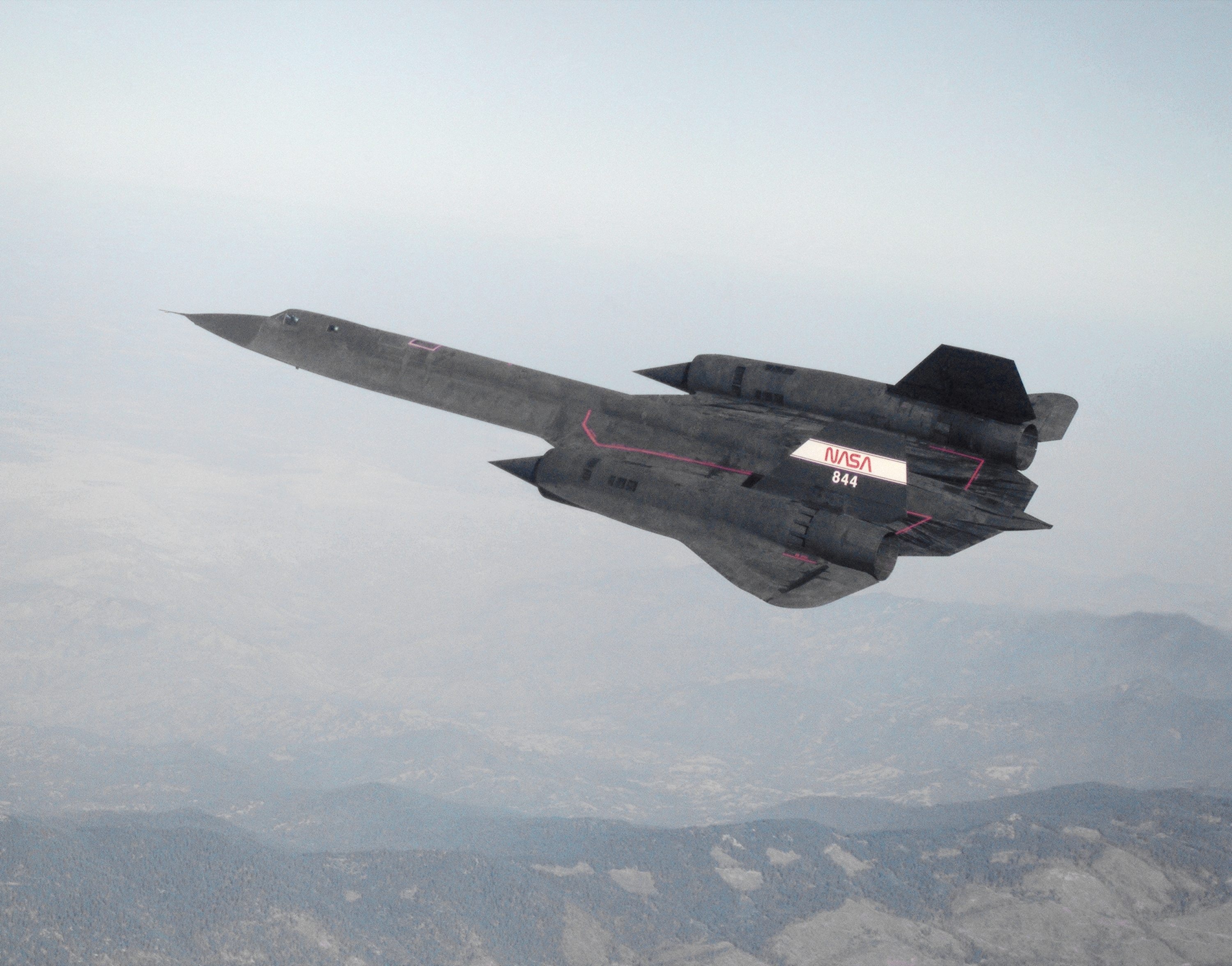


NASA Removes SR-71A 844 From Display
The aircraft at the center of the story is NASA 844, a Lockheed SR-71A carrying the original U.S. Air Force serial number 64-17980.
The Blackbird had been displayed outside NASA’s Armstrong Flight Research Center at Edwards Air Force Base in California since completing the final SR-71 flight on October 9, 1999.
Commercial satellite imagery reviewed by Aviation Week reportedly shows that the aircraft had been removed from its outdoor display position by May 17, 2026, and possibly several weeks earlier.
According to former SR-71 personnel interviewed by Aviation Week, NASA moved the aircraft into a hangar previously used to support Space Shuttle operations and began inspecting it.
Moving a retired aircraft into a hangar would not ordinarily indicate plans for a return to flight. Museum and display aircraft occasionally require structural inspections, preservation work and restoration after years of exposure to weather.
What happened next, however, made the story far more interesting.
Former Blackbird Personnel Reportedly Contacted
Aviation Week reports that NASA representatives contacted several former SR-71 engineers and staff members during the summer about supporting a possible return-to-flight project.
Mike Relja, a former U.S. Air Force and NASA SR-71 test engineer, told the publication that he received an offer to help with the effort. Another former NASA SR-71 test engineer, Tim Conners, was also reportedly approached.
Those contacts suggest that NASA may be doing more than simply preserving the aircraft for future display.
NASA has not publicly confirmed that a return-to-flight program exists. An agency spokesperson acknowledged the continuing public interest in the SR-71 but declined to provide additional information about tail number 844 or its removal from display.
No identifiable project budget, operational schedule or planned research mission has been announced.
NASA Administrator Teases New X-Planes
The reports arrive as NASA Administrator Jared Isaacman publicly discusses rebuilding the agency’s experimental X-plane portfolio.
During a September presentation at the All-In Summit in Los Angeles, Isaacman displayed the silhouette of a mysterious high-speed aircraft while discussing NASA’s future aeronautics plans.
The aircraft’s shape immediately drew comparisons to the SR-71, particularly its engine nacelles and inward-canted vertical stabilizers.
When asked whether the aircraft was a Blackbird, Isaacman did not provide a direct answer. He instead emphasized NASA’s intention to return to high-speed and high-altitude experimental flying.
That presentation does not confirm that the aircraft shown was NASA 844. It could represent an entirely new experimental design, a conceptual illustration or a separate classified research effort.
However, the timing of the presentation—combined with the movement of 844 and the reported outreach to former SR-71 personnel—has fueled speculation that NASA may want the original aircraft involved in a wider high-speed research program.
Why NASA Might Want a Blackbird
The SR-71 remains one of the most capable high-speed research platforms ever constructed.
The aircraft was designed to cruise at approximately Mach 3.2, exceeding 2,200 miles per hour, while operating at altitudes approaching 85,000 feet.
NASA operated two Blackbirds during the 1990s as research aircraft. Their speed and altitude capabilities supported studies involving aerodynamics, propulsion, high-temperature materials, atmospheric science, thermal protection, flight instrumentation and sonic-boom behavior.
Returning an SR-71 to flight could provide NASA with a proven platform for testing sensors, communications equipment, propulsion concepts or technologies intended for future supersonic and hypersonic aircraft.
It could also give engineers an airborne test platform while NASA develops newer experimental aircraft.
Readers interested in speed-focused aviation can also read about the SyberJet SJ30’s coast-to-coast speed record. Flight-simulation pilots interested in another iconic Cold War aircraft can explore Sky Blue Radio’s coverage of Heatblur’s modernized F-14B(U) Tomcat for DCS World.
Returning 844 to Flight Would Be Difficult
Even if NASA has decided to attempt a restoration, returning the aircraft to airworthy condition would present enormous technical and logistical challenges.
NASA 844 is approximately 59 years old and has not flown for nearly 27 years. It spent much of that time outdoors, where moisture, blowing sand and temperature changes may have affected its structure, engines, wiring and internal systems.
The specialized equipment, replacement parts and supply chain that supported the SR-71 no longer operate as they did during the aircraft’s service life. NASA would also need personnel familiar with the aircraft’s unusual systems, along with pilots, engineers, maintainers and ground crews qualified to operate it safely.
The Blackbird’s Pratt & Whitney J58 engines, fuel system, inlet controls and specialized support requirements make it far more complicated than restoring a conventional historical aircraft.
A successful effort would likely require extensive inspections, structural analysis, replacement components, ground testing, engine runs and a carefully controlled return-to-flight program.
What Is Confirmed—and What Is Not
Several important points are currently supported by available reporting:
- NASA 844 was removed from its long-standing outdoor display
- The aircraft was reportedly moved into a hangar for inspection
- Former SR-71 personnel say NASA approached them about assisting with a potential return to flight
- NASA leadership is publicly promoting a renewed X-plane program focused on high-speed and high-altitude research
Several equally important questions remain unanswered:
- NASA has not officially announced an SR-71 restoration program
- No budget or funding source has been identified publicly
- No test pilots, flight schedule or research mission have been announced
- NASA has not confirmed that the mystery aircraft shown during Isaacman’s presentation is SR-71A 844
NASA’s historical overview of SR-71A tail number 844 explains how the agency previously used the Blackbird for high-speed and high-altitude research.
For now, the possibility of an SR-71 returning to the air remains unconfirmed—but the aircraft’s disappearance from display, the reported work inside the hangar and NASA’s outreach to former Blackbird experts suggest this may be more than an aviation rumor.
If NASA 844 does fly again, it would mark the first Blackbird flight since 1999 and one of the most ambitious historic-aircraft returns ever attempted.