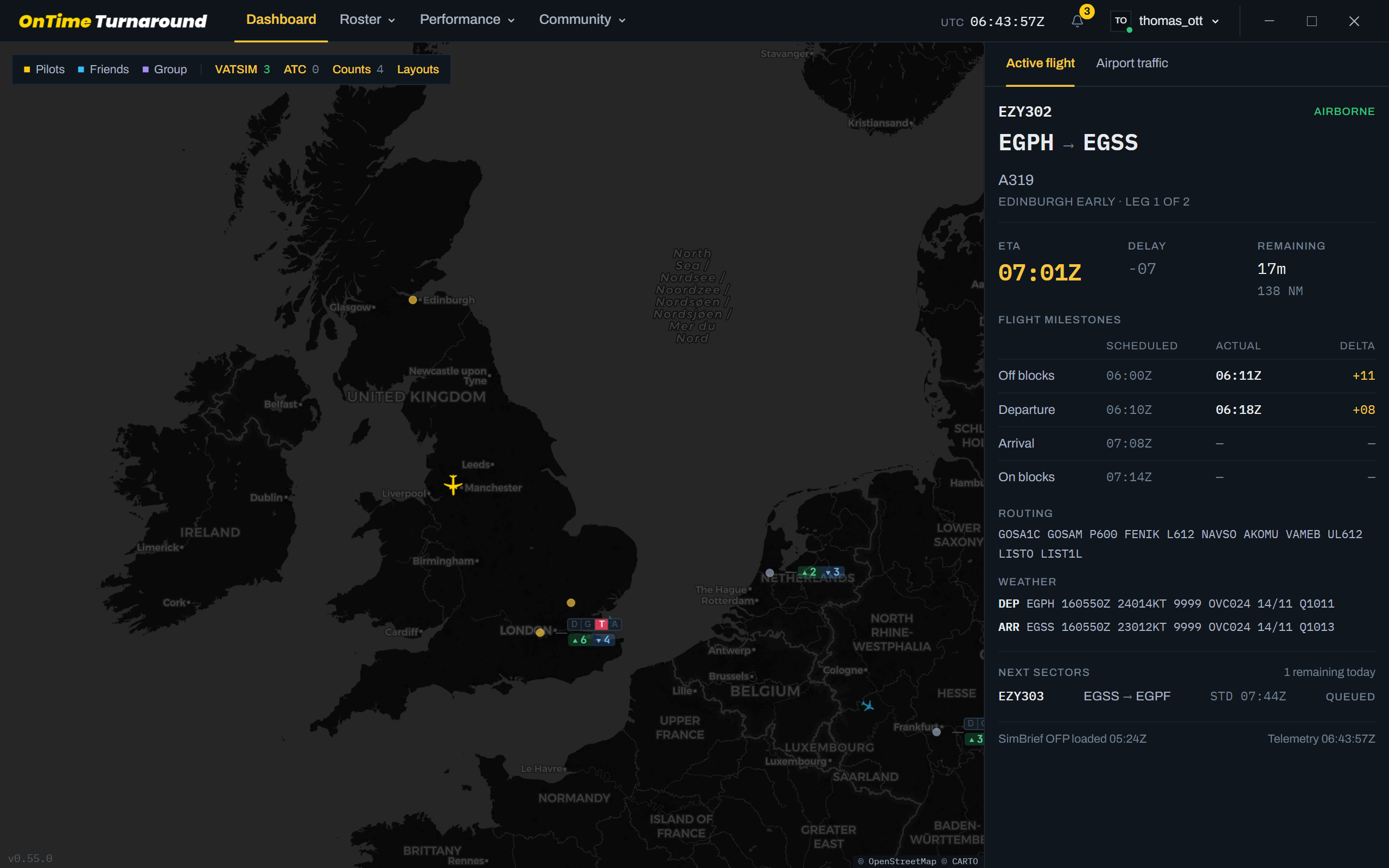


The Windows desktop application focuses on what happens between flights—and how one late arrival can affect the rest of a pilot’s schedule. Pricing has not yet been announced, but the developer is offering waitlist subscribers a 15 percent launch discount.
You might have nailed the landing. Dispatch would still like to know why the next departure is twenty minutes behind schedule.
One Late Flight Can Change the Whole Day
OnTime Turnaround builds its experience around a connected day of flying rather than isolated flights.
Pilots assemble a roster of sectors, with scheduled departure and arrival times. As they fly, the application tracks actual progress and carries delays into the remaining schedule.
The developer’s example illustrates a flight leaving 32 minutes late and recovering some time in the air. The remaining delay then consumes the available ground-time buffer before the next departure. A later turnaround provides another opportunity to recover the schedule.
For virtual pilots, that creates a different challenge: keeping an entire rotation moving while allowing time for the work between sectors.
Automatic Tracking and SimBrief Flight Plans
According to the developer, OnTime Turnaround reads simulator telemetry to identify key flight phases and record their times automatically.
SimBrief operational flight plans are attached to individual sectors, with the next plan prepared in the background. The aim is to let pilots concentrate on flying while the application maintains the operational picture.
That concept could appeal particularly to simmers who enjoy several shorter flights in one session. Regional airline fans can also revisit Sky Blue Radio’s coverage of FlightSim Studio’s E-Jets Version 1.0 release for another recent development in that style of flying.
Scoring, Rosters and Community Features
The published roadmap lists the roster builder, gate-to-gate tracking, logbook and post-flight debrief as deployed features.
Points, pilot ranks and leaderboards add a competitive element, while scheduled community events allow participants to fly a common roster within a set window.
A basic streaming overlay is also listed as deployed, giving creators a way to display flight information and schedule progress during broadcasts.
Together, those features position the application as an operational challenge for pilots who want their arrival time to matter beyond the end of a single flight.
Creator Previews Are Already Underway
In a September 30 development post, the team announced that its creators had unrestricted permission to showcase the current build ahead of launch.
The named creators include Drawyah, FlyWithJoel, GBarrow06 and HansHix, covering YouTube and Twitch.
The developer says the previews are intended to show the application in actual flying sessions, including any rough edges encountered along the way. Readers can find the channels through the official creator announcement.
Future Integrations Remain on the Roadmap
Several proposed additions are still outside the deployed feature list.
Roster continuation, simulator-time reference and direct virtual-airline integration are listed as planned development. GSX integration remains at the idea stage, so it should not be treated as a confirmed launch capability.
Readers interested in other approaches to airport turnaround activity can also explore our coverage of Apron Life’s AI ground services.
Launch Date and Requirements
The official store page lists support for Microsoft Flight Simulator 2020 and 2024 on Windows. FSUIPC7 must be installed and running; the application includes its own bridge.
As of October 8, checkout remains closed and the price is marked to be announced at launch.
Pilots can visit OnTime Turnaround’s website for the countdown, waitlist and development information.
If the October 10 launch proceeds as scheduled, virtual airline pilots will soon have another reason to watch the clock. The passengers may be imaginary, but the next departure is still waiting.