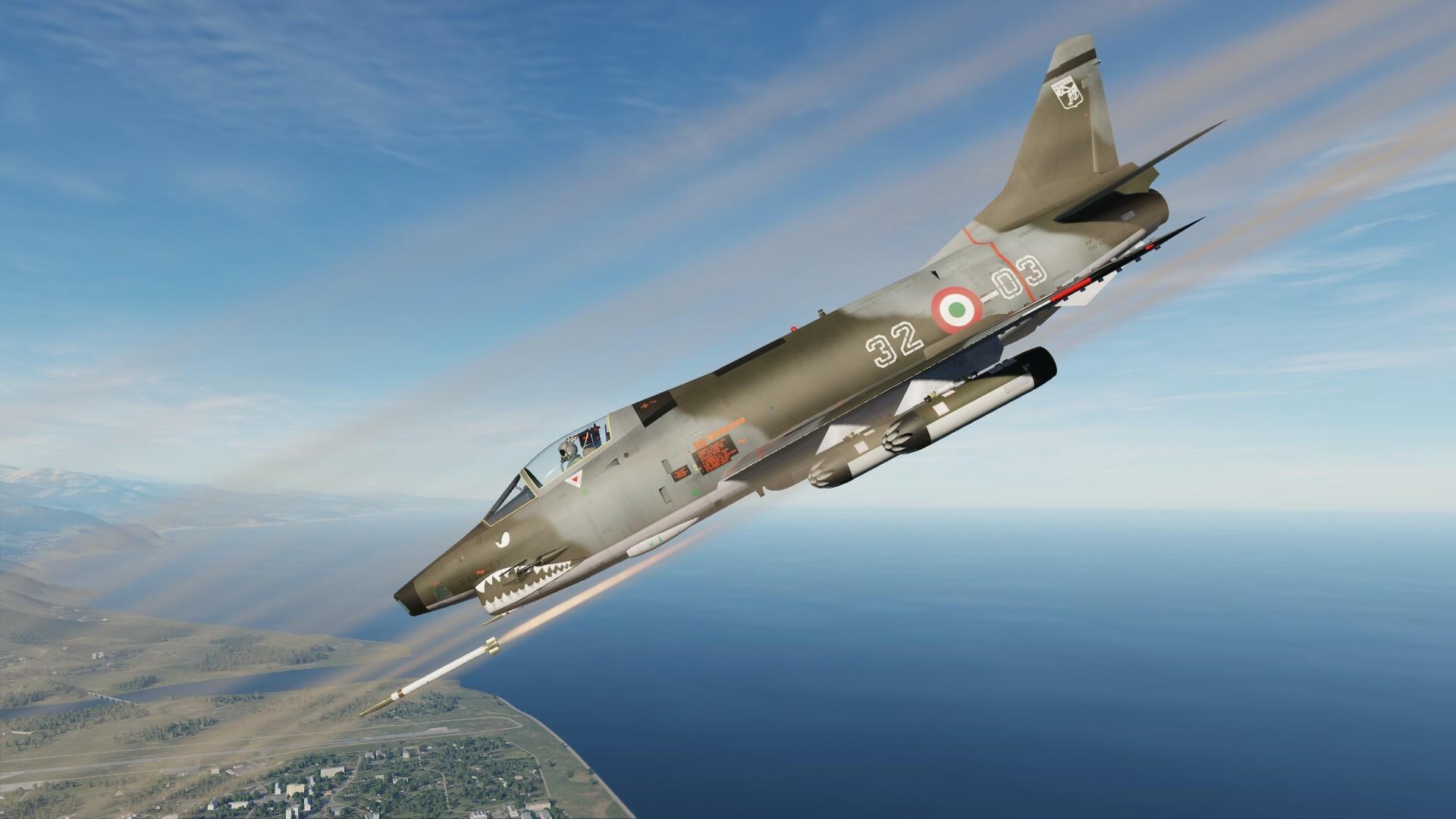


IndiaFoxtEcho Visual Simulations has shared a substantial new development report for the DCS: Fiat G.91R “Gina,” revealing progress across the aircraft’s flight model, engine, systems, weapons and damage simulation.
Published through Eagle Dynamics on September 4, the update marks an important stage in development. Rather than concentrating on individual features, the team is now bringing the aircraft’s major systems together into a functioning simulation.
The result is shaping into a particularly interesting addition to DCS World’s Cold War lineup: a compact tactical jet that combines straightforward flying with the sort of mechanical and procedural depth that rewards pilots who actually read the manual.
A Custom Flight Model Built Around the Aircraft
The G.91R uses a fully custom External Flight Model that calculates aerodynamic forces from the aircraft’s individual components.
The wings, tail, fuselage, flaps, landing gear and airbrakes all contribute independently to the aircraft’s behavior. That allows changes in configuration, asymmetric loads and damage to influence handling rather than relying on a single generalized flight model.
IndiaFoxtEcho says the simulation includes progressive stalls, wing drop, autorotation, spin tendencies, ground effect and transonic behavior. Control effectiveness and aerodynamic damping also change with speed and airflow.
For pilots, that should mean the Gina feels responsive when flown smoothly but becomes increasingly demanding when pushed beyond its limits. It is a small aircraft, but the developer is clearly not treating it as a simple one.
The Orpheus Engine Has Its Own Personality
The aircraft’s Bristol Siddeley Orpheus engine simulation has also continued to mature.
Engine response is influenced by altitude, airspeed, inlet conditions and pilot handling. RPM and Jet Pipe Temperature change progressively, while aggressive maneuvering or poor inlet conditions can produce compressor disturbances, surges and flameouts.
The developer is also adding cockpit vibration as a form of feedback during abnormal engine operation, giving pilots a physical indication that something is wrong before the instruments tell the entire story.
That kind of detail is particularly appropriate for an aircraft from an era when engine management required considerably more attention from the person sitting behind it.
Four JATO Rockets Are Ready for Takeoff
One of the most dramatic features in the update is the G.91R/1B’s completed four-rocket JATO installation.
The Jet-Assisted Takeoff system includes its own electrical controls, READY indication, ignition sequence, cockpit vibration and jettison logic. Each rocket contributes thrust based on its actual position and orientation beneath the aircraft.
That means the system is not simply a visual effect or a temporary boost applied to the aircraft.
The rockets are integrated into the flight model, giving the Gina a distinctive short-field capability and one of the more memorable takeoff procedures likely to appear in a DCS module.
Four rockets under a small tactical jet should also make for a departure that is difficult to describe as subtle.
Electrical, Hydraulic and Fuel Systems Come Together
IndiaFoxtEcho has made major progress connecting cockpit controls to the systems they actually operate.
Electrical buses, switches, relays and circuit protection determine whether equipment is available. The hydraulic model supports flight-control servos, landing gear, flaps, wheel brakes, emergency braking and accumulator-powered emergency functions.
The developer notes that losing electrical power does not necessarily prevent a mechanical control from moving, but it may prevent the associated system from responding.
The fuel system is receiving similar treatment.
Rather than relying only on a global fuel quantity, the simulation models main tanks, pumps, transfer paths and supply logic. Fuel delivery to the engine therefore depends on the actual configuration and condition of the system.
Cold-and-dark and hot-start configurations also establish appropriate initial aircraft states, while cockpit instrumentation has expanded to cover engine, trim, flap, airbrake, hydraulic-pressure, fuel and flight-condition indications.
The important takeaway is that normal and emergency procedures are becoming meaningful parts of operating the aircraft, not simply switches that trigger predetermined animations.
Weapons Bring Cold War Challenges
Weapon development is currently concentrated heavily on the G.91R/1B, which IndiaFoxtEcho describes as the most complete test platform.
The aircraft’s guns, bombs, podded rockets and externally mounted rockets are connected to their dedicated cockpit circuits, selectors and release sequences.
Bombs can be released individually or together, while rocket firing supports single, automatic and grouped modes with appropriate left-right sequencing. Ground firing is inhibited by the landing-gear microswitch, and selective, salvo and emergency jettison functions follow their own operating rules.
These details should give the aircraft a very different character from modern multirole fighters, where much of the workload is managed through digital displays and highly automated weapon systems.
The Nord AS-20 Requires Actual Piloting
The Nord AS-20 is another major part of the weapons development.
This early manually guided missile requires the pilot to launch the weapon, visually track it and steer it toward the target throughout its flight.
There is no modern fire-and-forget convenience here. The pilot must manage the aircraft while also guiding the missile, making successful employment a demanding exercise in coordination and concentration.
The G.91R/4 will also retain its dedicated Sidewinder capability.
IndiaFoxtEcho is continuing to develop separate equipment and system configurations for the PAN, R/1B, R/3 and R/4 variants, rather than treating every version as the same aircraft with a different paint scheme.
Structural Damage Can Change the Way Gina Flies
The structural damage model has moved from preparation into active integration, and this may be one of the most interesting parts of the entire project.
Instead of relying solely on generic damage thresholds, the aircraft tracks loads acting on important sections of the airframe.
High-G maneuvers, asymmetric stores, excessive speed with flaps extended and battle damage can progressively reduce structural integrity. Damage may therefore affect the aircraft before a component fails completely.
A damaged wing or control surface could change handling characteristics, forcing the pilot to adapt and carefully bring the aircraft home.
That creates a much more interesting consequence for overstressing the jet than simply reaching a numerical limit and watching something detach.
It also gives pilots a reason to respect the aircraft’s operating envelope, particularly when carrying asymmetric loads or recovering from combat damage.
Navigation and Life-Support Systems Are Next
The next stage of development will focus on the PHI navigation system and ADF, along with further work on pressurization and oxygen systems.
IndiaFoxtEcho also plans to continue expanding the damage model beyond the aircraft’s structure to include more interactions with surrounding systems.
That means the project is still actively evolving, even though many of its major components are now working together.
The developer has not announced a release date in this report.
A Different Kind of DCS Jet
The G.91R occupies an interesting place in the DCS World lineup.
It is not a modern fighter built around advanced radar, digital displays and long-range precision weapons. Its appeal comes from a different kind of flying: managing a relatively small tactical jet, understanding its mechanical systems and employing weapons that demand direct pilot involvement.
The latest development report suggests IndiaFoxtEcho is leaning heavily into that character.
The custom flight model, Orpheus engine, four-rocket JATO installation, manually guided AS-20, detailed hydraulic and fuel systems, and progressive structural damage are all being developed to work together.
There is still work ahead, particularly in navigation, life-support systems and the broader damage simulation.
But the Gina is now moving beyond a collection of promising individual features.
It is beginning to look like a complete Cold War tactical aircraft, and one that may be considerably more demanding than its compact size suggests.
For DCS pilots who enjoy aircraft where smooth handling, system knowledge and a little mechanical sympathy matter, the G.91R is becoming a project worth watching.