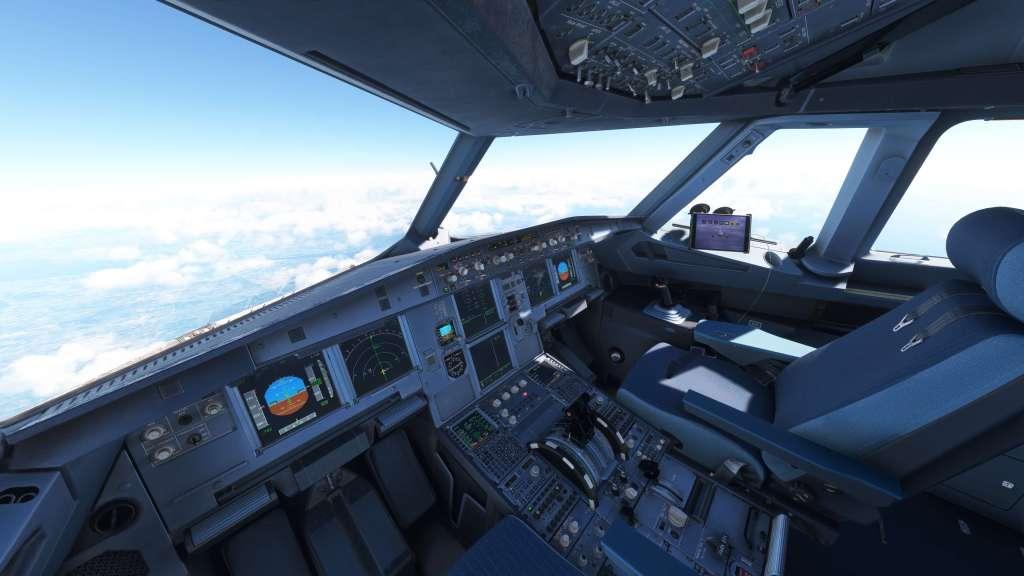


After months of relative silence, Fenix Simulations has returned with one of the biggest announcements of the year for Microsoft Flight Simulator pilots.
The developer has unveiled Version 3.0 of its highly regarded Airbus A320 family, detailing an extensive overhaul that reaches far beyond the flight management and ECAM improvements originally promised.
In a presentation lasting nearly two hours, Fenix demonstrated improvements to the aircraft's flight dynamics, fly-by-wire controls, navigation systems, engine management, cockpit displays, cabin operations, sound environment, and more.
The company describes Version 3 as its largest product improvement to date, and perhaps the best news for existing customers is that the entire update will be free.
Fenix is targeting release during the week of October 19, with support for both Microsoft Flight Simulator 2020 and Microsoft Flight Simulator 2024.
An Aircraft That Flies Differently
One of the most significant improvements involves how the Airbus behaves in flight.
Fenix has reworked the aircraft's flight model, including inertia calculations, fly-by-wire logic, flight director behavior, and autopilot response.
The improvements are intended to make the aircraft feel more natural throughout every stage of flight, from rotation and initial climb to cruise, descent, and landing.
The development team worked with real Airbus pilots and compared its simulation against certified full-flight simulators to refine aircraft handling.
Ground operations have also received attention. A new hybrid taxi model addresses several Microsoft Flight Simulator ground-handling limitations, providing more consistent taxi, braking, and single-engine taxi behavior.
For pilots who enjoy hand-flying the Airbus, these changes could make Version 3 one of the most meaningful updates since the aircraft's original release in 2022.
A Complete Rebuild of VNAV and LNAV
Flight management has been another major focus.
Fenix has rewritten its vertical and lateral navigation systems, drawing heavily on the behavior of the real Thales flight management system.
The improvements include more realistic descent planning, deceleration calculations, holding patterns, navigation transitions, and performance adjustments.
Rather than simply smoothing out existing behavior, the developer has rebuilt much of the underlying logic to reproduce how the real Airbus calculates and manages a flight.
The result should be particularly noticeable during complex arrivals, altitude constraints, and approaches requiring precise energy management.
ECAM and Flight Warning Computers Rebuilt
The aircraft's Electronic Centralized Aircraft Monitor, better known as ECAM, is receiving one of its most extensive changes.
Fenix has developed a new flight warning computer simulation that more closely reproduces the timing, processing, and behavior of the real aircraft.
The two flight warning computers operate independently, introducing subtle timing differences that occur in actual Airbus systems.
Warning messages, aural alerts, takeoff configuration checks, system indications, and ECAM procedures have also been revised.
Even small details, such as the timing of engine indications and the distinctive sound of certain cockpit warnings, have been modeled using real-world reference material.
The new architecture also prepares the aircraft for potential future features such as persistent aircraft states and a Minimum Equipment List system, although those features are not part of the Version 3 release.
A New Generation of Engine Simulation
Version 3 introduces a redesigned Full Authority Digital Engine Control system, commonly known as FADEC.
The new engine control architecture was developed partly to support the different engine families planned for Fenix's upcoming A320neo products.
For current A320ceo owners, the changes include more detailed engine-start behavior, improved engine management, and additional airline-specific operating options.
Fenix demonstrated how the CFM56 and IAE V2500 engines behave differently when certain electrical or control systems are interrupted.
The developer says these differences result from the simulation of the underlying systems rather than specially scripted responses.
Your Cabin Crew Just Got a Job
One of the more unexpected additions is a substantial expansion of cabin simulation.
Version 3 introduces a modeled Cabin Intercommunication Data System and an interactive Flight Attendant Panel.
Pilots will be able to interact with cabin-related systems, while a new virtual purser manages routine passenger cabin operations.
The virtual crew can handle announcements, lighting changes, cabin preparations, and other activities throughout the flight.
Fenix has also introduced airline-specific announcement packs and additional cabin details, including modeled water and waste systems.
Passenger numbers and flight duration can influence water usage and waste accumulation, which can also affect the aircraft's center of gravity.
It's an unusually detailed addition for an airliner simulation, bringing more of the passenger experience into the virtual cockpit.
New Sounds, Headset Features, and Cockpit Movement
The audio environment is also receiving a major overhaul.
Fenix has reworked its CFM56 and V2500 engine sounds and introduced a custom binaural audio implementation designed to improve the sense of space and direction inside the aircraft.
Another notable addition is active noise cancellation associated with the pilot's headset, allowing the simulated cockpit sound environment to change depending on whether the headset is being worn.
Visual improvements include physics-based cockpit animations, allowing certain cockpit fixtures to react subtly to turbulence and ground movement.
Additional refinements include cabin window effects, revised settings menus, and a searchable quick reference handbook within the Electronic Flight Bag.
These changes are designed to make the aircraft feel more cohesive, rather than simply adding isolated features.
What About the Fenix A320neo?
Naturally, the announcement raises questions about the long-awaited Fenix A320neo family.
The good news is that development continues.
Much of the underlying technology introduced in Version 3 was created with the upcoming neo aircraft in mind, particularly the engine simulation, systems architecture, and avionics.
Fenix has indicated that the majority of its development team has returned to work on the neo program after concentrating on the current A320 family.
However, no release date has been announced for the A320neo.
For now, the developer's immediate priority is delivering Version 3 to existing customers.
When Can Pilots Get It?
Fenix is targeting the week beginning October 19, 2026, for the Version 3 rollout, although an exact release date has not been confirmed.
The update will be available at no additional charge to existing Fenix A320 customers, including owners of the A319/A321 expansion, and will support both MSFS 2020 and MSFS 2024.
Given the scale of the changes, this is considerably more than a conventional aircraft patch. Fenix has effectively rebuilt major parts of its Airbus simulation while retaining the aircraft that existing customers already own.
For flight simulation enthusiasts who value detailed systems, realistic aircraft handling, and immersive airline operations, Version 3 is shaping up to be one of the most significant airliner updates of 2026.
And with the A320neo still in development, the next chapter for Fenix Simulations may be just as interesting.
Sky Blue Radio will continue following the rollout and bring you the latest information when Version 3 becomes available.