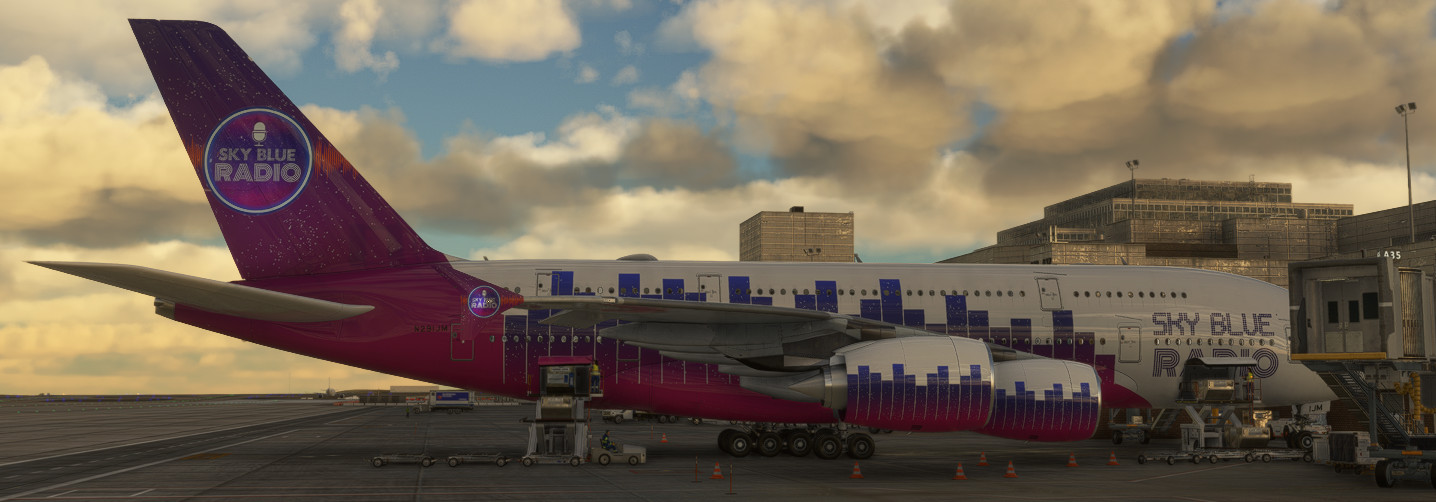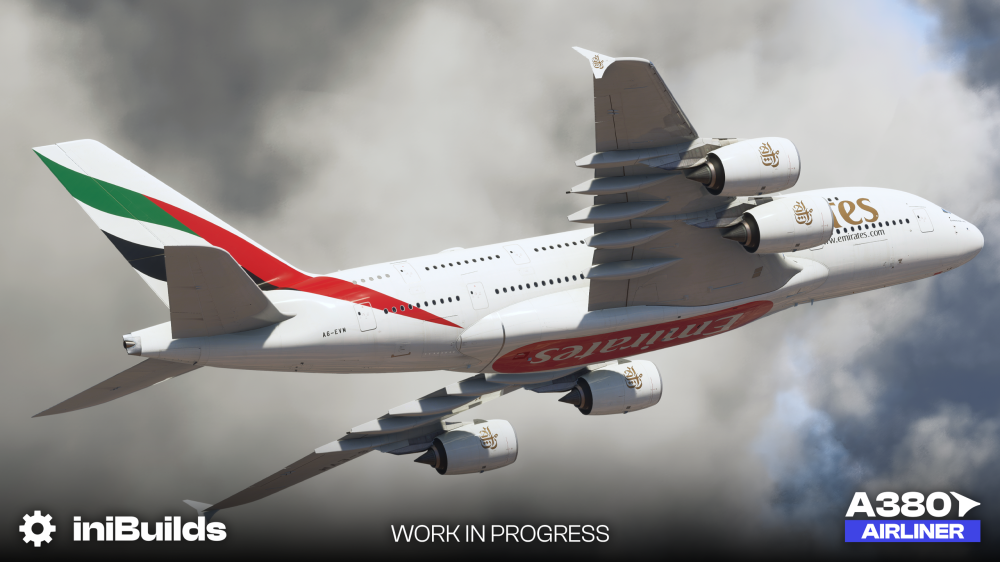


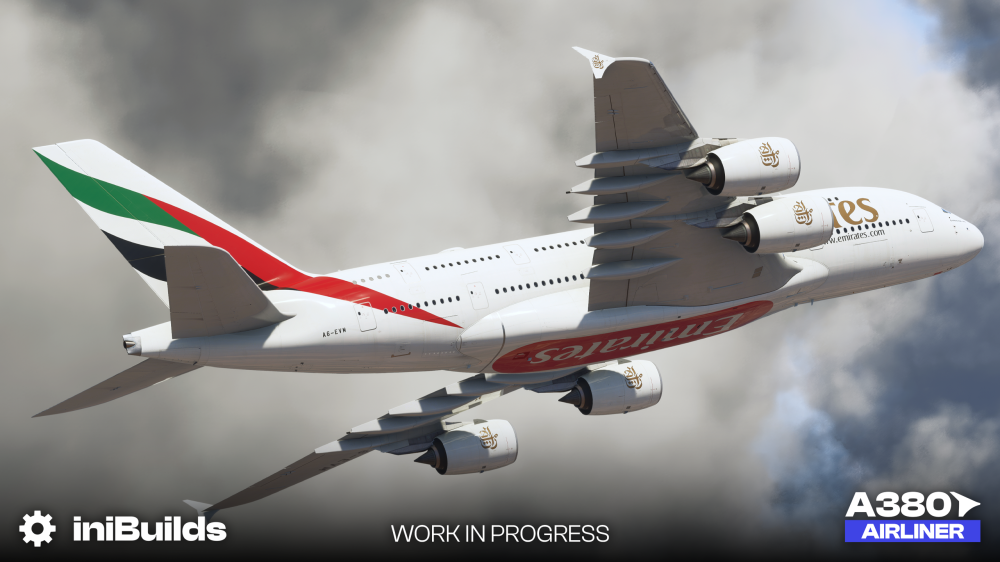

During a roughly two-hour developer deep dive on the official Microsoft Flight Simulator Twitch channel, iniBuilds flew a British Airways A380 from Cardiff to London Heathrow, demonstrating the aircraft’s systems, cabins, engines, performance options, failure logic, flight controls, and ground operations along the way.
The presentation gave the community its clearest look yet at how the long-awaited superjumbo will actually behave once it reaches users.
And while iniBuilds still did not provide a release date, the company once again described release as coming “soon.”
Cardiff to Heathrow Shows the A380 in a Real Flight
The demonstration was hosted by members of the iniBuilds aircraft development team and followed a short Cardiff-to-Heathrow flight.
That route was not chosen randomly.
A380s have used Cardiff for heavy maintenance work, making the sector a plausible real-world positioning flight for a British Airways aircraft.
The flight began using Microsoft Flight Simulator’s World Update 17 Cardiff scenery and ended at iniBuilds’ own Heathrow Airport.
That gave the team enough time to walk viewers through the aircraft without turning the livestream into a 14-hour expedition to Singapore.
Performance Was One of the Biggest Questions
One concern has followed the iniBuilds A380 almost from the moment its detailed cabin and systems were revealed:
How is a computer supposed to render all of this?
iniBuilds spent a considerable portion of the presentation talking about exactly that.
The aircraft uses Microsoft Flight Simulator’s normal Level of Detail system, but iniBuilds has also developed additional techniques that dynamically unload parts of the aircraft when they are not needed.
One example is the cabin.
When the aircraft doors are closed, the cabin can be completely unloaded from rendering. Open a door, and it returns.
That reduces unnecessary CPU and GPU workload while pilots are sitting in the flight deck.
There Is Also a No-Cabin Option
Pilots who have absolutely no desire to tour the showers, bar, or passenger decks can go one step further.
iniBuilds confirmed a no-cabin option for users who want to prioritize performance.
The developers were careful not to promise miraculous FPS gains.
Instead, the optimization work is aimed mainly at reducing stutters and poor frame timing, particularly while moving the camera around the cockpit.
iniBuilds says the goal with Performance Mode enabled is to have the A380 running in roughly the same performance territory as its current A350, with additional optimization work still underway.
Xbox Testing Is Already Underway
The A380 is not being developed solely for high-end PCs.
iniBuilds confirmed that the Xbox version is already in testing and is running successfully.
PlayStation 5 is less certain.
The developer said it would like to bring the A380 to PS5 but still has several technical or platform hurdles to work through first.
The aircraft also works with ChasePlane, with iniBuilds noting that many of its testers use the camera utility alongside Performance Mode.
Two Different Cabins Are Included
The livestream also clarified something that had not previously been entirely obvious.
The A380 will ship with two different cabin configurations.
One is the elaborate Emirates-inspired four-class cabin that iniBuilds has previously shown.
That includes the recognizable:
- Shower spas
- Onboard lounge and bar
- Premium cabins
- Decorative lighting
- Star ceiling effects
- Multiple cabin zones
The second is a more neutral basic cabin, intended to fit airlines that do not operate an Emirates-style interior.
The British Airways aircraft used during the livestream was fitted with that more generic configuration.
Yes, the Shower Actually Uses Water
Some of the more eccentric A380-specific systems remain fully functional.
The onboard shower has an operational timer, and using it consumes water from the same simulated potable-water system serving the aircraft’s lavatories.
That system is persistent.
If the aircraft is repeatedly operated without properly servicing its water and waste systems, lavatories and other facilities can eventually become unavailable.
So the A380 may be the first airliner add-on where forgetting to service the airplane can eventually result in a first-class passenger discovering the shower has gone on strike.
Trent 900 and GP7200 Are Truly Different Engines
iniBuilds demonstrated more of the differences between the A380’s two available engine families:
Rolls-Royce Trent 900
and
Engine Alliance GP7200
These are not simply different exterior models with different sound sets.
The Trent 900 is modeled as a three-spool engine and displays N1, N2, and N3 indications.
It also uses an automatic climb-thrust derate based on aircraft weight and a modified takeoff thrust system.
The GP7200 uses a two-spool architecture with N1 and N2 indications and handles thrust derates differently, using manually selected steps.
That means switching engine variants should actually change cockpit procedures and engine-management behavior.
Two Generations of A380 Avionics
The A380 will also let pilots choose between two different avionics standards.
iniBuilds has modeled:
- An older Batch 2 standard from around 2010
- A newer Batch 7 standard
The selected configuration changes parts of the aircraft’s avionics and FMS presentation.
That helps the aircraft better represent different operators and different periods of A380 service.
Combined with the cabin choices and two engine families, one purchase is intended to cover a surprisingly broad range of real-world A380 configurations.
The New EFB Handles More Than Setup
The A380 introduces iniBuilds’ latest Electronic Flight Bag architecture.
The EFB handles SimBrief importing, ground operations, GSX loading, aircraft options, and various operational functions.
One particularly useful feature is intersection takeoff performance calculation.
If the crew intends to depart from an intersection rather than using the full runway length, the EFB can account for the reduced runway automatically instead of forcing pilots to manually calculate or enter the shorter distance.
Takeoff and landing performance calculations are handled through the aircraft’s OIS and can feed the resulting speeds into the FMS.
Brake to Vacate Is Fully Integrated
The demonstration also showed Brake to Vacate, one of the A380’s signature systems.
BTV allows crews to select a desired runway exit and have the aircraft calculate braking required to reach it.
The system works alongside runway overrun protection, giving pilots additional information about whether the aircraft can safely stop within the available runway.
On an aircraft this large, vacating the runway efficiently is not a trivial concern.
An A380 occupying a runway tends to become everyone else’s problem remarkably quickly.
Weather Radar and Vertical Displays Are Included
The aircraft includes:
- Weather radar
- Terrain display
- Vertical display
- Hoppie CPDLC
- Fuel dumping
- Dynamic checklists
- OANS airport navigation
The systems are integrated into the broader avionics environment rather than functioning as isolated visual features.
The checklist system can also recognize certain aircraft states and identify items that have not been completed.
Failures Go Well Beyond an Engine-Off Switch
iniBuilds spent considerable time demonstrating its failure system.
Failures can be triggered immediately or configured dynamically, allowing them to occur randomly during a flight.
The system also contains what iniBuilds calls situations, where the exact outcome may not be completely predictable.
Examples shown or discussed included:
- Fuel leaks
- Engine high vibration
- GPS jamming
- Bird strikes
- Engine failures
- Fire scenarios
A bird strike can even cause visible exterior damage while simultaneously failing an engine.
Fire Bottles Are Not Magic
One particularly interesting piece of failure logic involves engine fires.
Discharging a fire bottle does not automatically guarantee that the fire will go out.
That introduces some uncertainty into abnormal procedures.
The A380’s ECAM logic is also considerably more complicated than what many pilots may know from smaller Airbus aircraft.
iniBuilds says some procedures can branch into several pages and defer additional actions into the electronic checklist system.
That should make abnormal operations one of the more demanding parts of the simulation.
The Fly-by-Wire System Was Rebuilt for the A380
The A380 does not simply reuse the A350’s flight-control model.
iniBuilds says the fly-by-wire system has been heavily retuned and substantially rebuilt specifically for the superjumbo.
That includes a custom rotation law.
During takeoff, the system expects a single pull on the sidestick to initiate rotation rather than continuous increasing back-pressure.
The software then manages the resulting pitch response.
That behavior is intended to reflect how the real A380’s flight-control system handles rotation despite enormous variations in aircraft weight.
Taxiing the A380 Is Its Own Skill
Taxiing also received plenty of attention during the livestream.
The nosewheel can only steer at a maximum rate of approximately 14 degrees per second, meaning pilots need to feed steering inputs in gradually rather than suddenly demanding large changes.
The aircraft’s body landing gear also steers.
That is essential on the real aircraft because the enormous wheelbase and weight would otherwise cause excessive scrubbing and skidding during tight turns.
The simulated A380 can also begin rolling at idle thrust when relatively light, while heavier configurations may require breakaway thrust to get moving.
Jump Ahead Makes Long Flights Easier
For users who want to operate long-haul routes without necessarily sitting at the computer for 13 hours, iniBuilds has included several time-saving tools.
The aircraft can jump ahead to a selected waypoint or phase of flight.
It also supports:
- Time acceleration
- Automatic step climbs
- Pause at top of descent
- Autosave
That should make the A380 far more practical for users who want realistic long-haul operations but do not always have an entire day available.
Multi-Jetway Docking Was Demonstrated at Heathrow
After the manual landing at Heathrow, iniBuilds demonstrated its Multi-Jetway Technology.
Several jetways connected to the A380 simultaneously at the gate.
The technology was originally developed with aircraft such as the A380 in mind, where loading hundreds of passengers through a single boarding bridge would be rather optimistic.
The system allows supported airports and aircraft to use several jetways without relying on additional external software.
Some Cabin Features Were Deliberately Left Out
The livestream also revealed several areas where iniBuilds deliberately chose performance over absolute completeness.
There will be no animated evacuation slides, largely because of the performance cost associated with modeling such enormous objects.
Door arming and disarming logic is still modeled, however, and opening an armed door can result in a failed deployment indication.
Most overhead bins will not open.
Most window shades are fixed, although selected blinds remain functional.
The EFB can also randomize window-shade positions to make the cabin look less uniform.
The philosophy appears to be simple: deeply simulate features pilots are likely to interact with while avoiding expensive animations that provide little operational value.
Still No Release Date
The question everyone wanted answered remains unanswered.
When is the iniBuilds A380 coming out?
iniBuilds did not provide a release date during the livestream.
The team only said the aircraft is coming “soon.”
Before release, iniBuilds plans to publish a “Welcome to the A380” video series, potentially split into two parts, designed to introduce users to the aircraft and its operation.
The aircraft will also be shown at Flight Sim UK at Bristol Aerospace on October 10 and 11.
Seven Years in the Making
The A380 project has a particularly long history.
iniBuilds originally announced the aircraft in 2019, making it one of the company’s earliest major aircraft projects.
Development has evolved significantly since then.
The project moved through earlier simulator plans, was shelved, and eventually returned as a completely rebuilt aircraft for Microsoft Flight Simulator.
iniBuilds has also gained access to a full-motion A380 simulator and an aircraft in storage to collect performance data, cockpit measurements, system behavior, and procedural references.
The result is now much closer to something customers can actually fly.
The A380 Finally Feels Close
There is a big difference between seeing screenshots of an unfinished aircraft and watching developers complete an entire flight with it.
The Cardiff-to-Heathrow demonstration showed the A380 starting, taxiing, flying, navigating, landing, and connecting to multiple jetways at the destination.
It also showed the systems underneath all of that working together.
Two engine families.
Two avionics generations.
Two cabin styles.
Brake to Vacate.
Failures.
Dynamic checklists.
Weather radar.
OANS.
A new EFB.
Custom flight controls.
And performance tools designed specifically to keep one of the largest aircraft ever modeled for MSFS from turning a gaming PC into a decorative space heater.
There is still no date.
But after years of development, the iniBuilds A380 is no longer something we are simply being told about.
We have now watched it fly.
And that makes “soon” feel considerably closer than it did before.