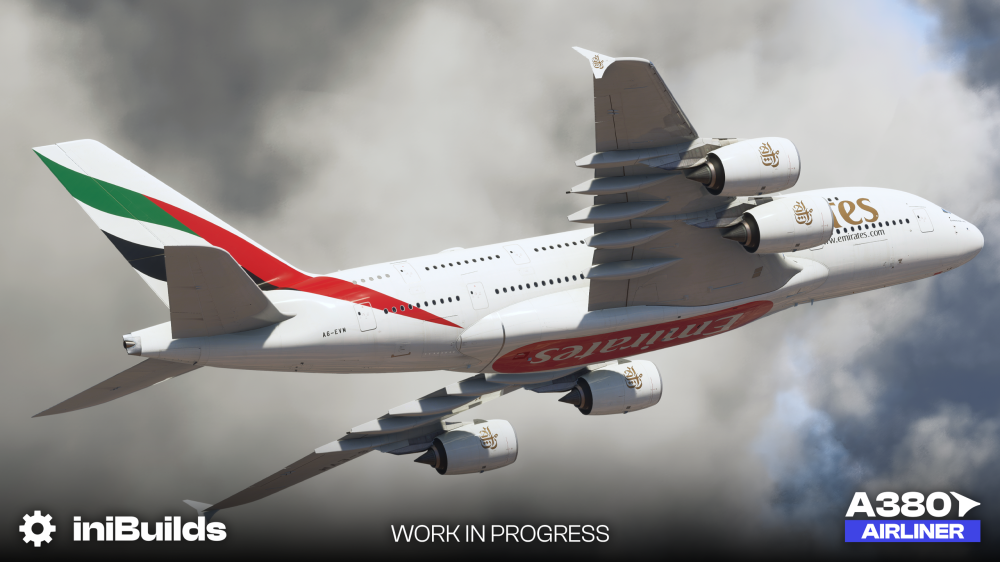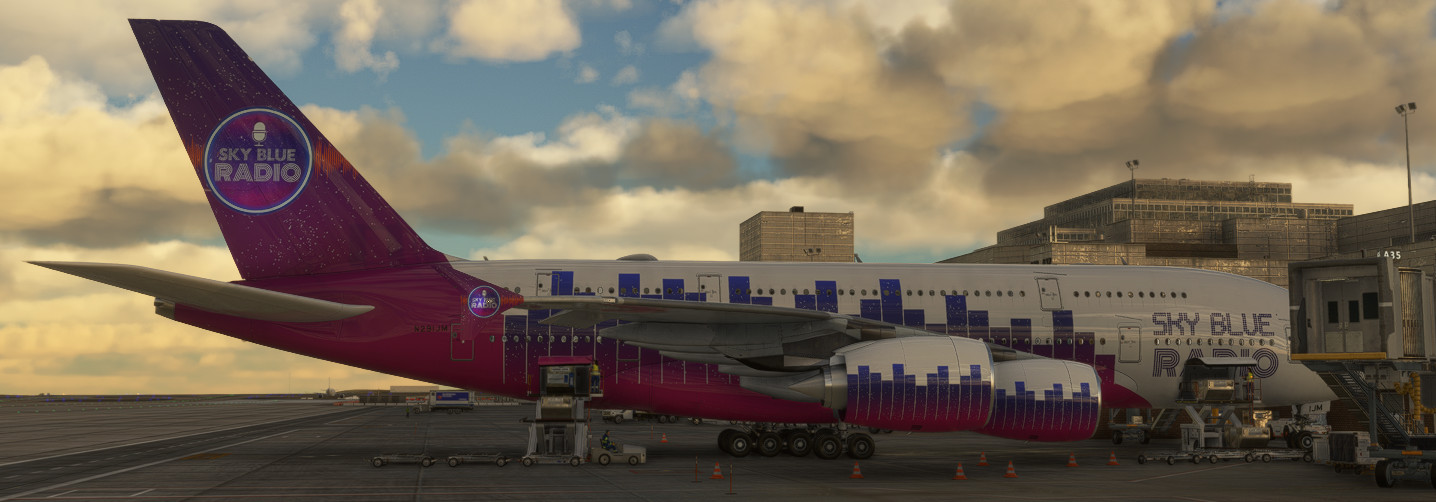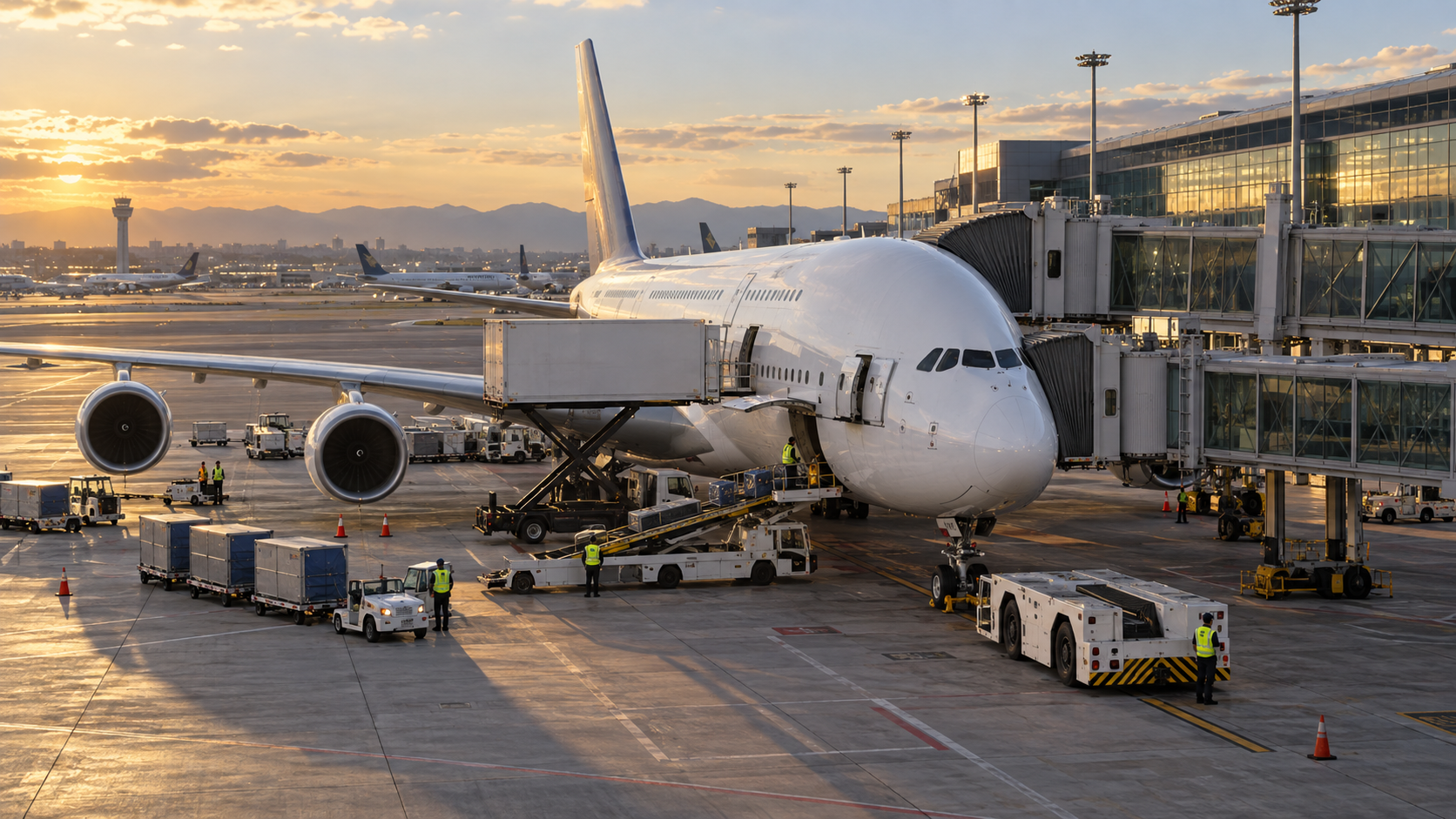


The A380 update dives into persistent aircraft states, realistic ground servicing, Brake to Vacate, Runway Awareness and Advisory System logic, weather radar, fuel temperature, custom wing flex, failures, dual engine variants and extensive MSFS 2024 walkaround functionality. At the same time, iniBuilds confirmed that the A350 V2 will be a free upgrade for all existing A350 Airliner customers.
A380 Persistence Means the Aircraft Remembers What You Did
One of the more interesting additions is a new aircraft persistence system.
The iniBuilds A380 will be able to remember fuel quantities, switch positions and system conditions between simulator sessions. Instead of every flight beginning with a freshly reset aircraft, pilots can return to the jet in roughly the same condition they left it.
That persistence goes beyond the cockpit.
The aircraft’s potable-water and waste systems are fully simulated, including water use, waste accumulation and servicing. Ignore those systems for multiple sectors and the consequences will carry forward. iniBuilds specifically notes that failing to service the aircraft long enough could eventually leave the lavatories and first-class showers unavailable.
That might be the most A380 way possible to discover you forgot part of the turnaround checklist.
Multi-Jetway Boarding for the Double-Decker
The A380 is also fully compatible with iniBuilds’ Multi-Jetway Technology.
At supported airports, several jetways can connect to the aircraft at once, allowing simultaneous boarding and deboarding of the two-deck airliner. iniBuilds says the system was originally created specifically because of the A380 before being expanded for use with other compatible aircraft and airports.
GSX integration has also been upgraded to a new V2 implementation, with revised communication logic, dedicated notifications and a state panel showing active ground-service operations.
More Advanced Takeoff Planning
The A380’s electronic flight bag continues to grow in depth.
Its takeoff calculator can determine V-speeds, FLEX temperature and stopping margin using aircraft weight, configuration, weather and runway conditions.
It also supports intersection departures, meaning pilots can select a specific runway intersection and have the reduced available runway distance automatically factored into the performance calculation.
The onboard information system is also receiving expanded avionics functions, improved chart handling and a new notification center.
Multi-page Lido charts are supported, and iniBuilds has reworked numeric entry to use a more conventional numpad layout.
Brake to Vacate Makes the Cut
One of the most recognizable A380 systems confirmed in the update is Brake to Vacate, or BTV.
The simulated system predicts runway-exit performance and helps pilots select the most appropriate exit during arrival planning. It also calculates expected runway-vacating information based on the planned exit.
The A380 also includes a fully integrated Runway Awareness and Advisory System, providing runway-related alerts during taxi, approach and landing operations.
For pilots flying into enormous hubs where a wrong turn can become a 15-minute sightseeing tour of Terminal 3, those systems should be more than decorative extras.
Weather Radar Uses New MSFS 2024 Capabilities
iniBuilds says the A380’s weather radar is taking advantage of newer simulator API improvements.
Pilots will be able to control radar tilt and azimuth to scan precipitation ahead of the aircraft more realistically.
Fuel temperature is also simulated individually across the aircraft’s tanks.
Temperature changes according to altitude, ambient conditions and flight duration. If fuel temperatures move outside the expected operating range, the aircraft can generate the appropriate ECAM indications and require crew action.
The Landing Gear Is Not Just One Giant Animation
Recreating an A380 touchdown presents some unusual challenges.
The aircraft has multiple landing-gear bogies and body-gear steering, so iniBuilds has built the complete configuration into the MSFS 2024 flight model rather than treating the gear as one simplified contact system.
The rear body gears physically steer during ground operations, while the individual gear assemblies respond separately during taxi and touchdown.
Using additional contact points and MSFS 2024’s suspension modeling, the aircraft can settle progressively across the different bogies during landing rather than snapping onto the runway as if all the wheels touched simultaneously.
Custom A380 Rotation Logic
The flight-control work goes deeper than ordinary fly-by-wire tuning.
iniBuilds has developed A380-specific rotation laws that model the transition between ground roll, rotation and flight while accounting for the aircraft’s enormous range of operating weights.
Sidestick input is translated into an appropriate pitch response whether the aircraft is relatively light or near maximum takeoff weight.
The wings also use a custom dynamic-flex system.
Instead of following a preset visual animation, wing movement responds continuously to aerodynamic load, aircraft weight, turbulence and maneuvering forces.
Failures Are Being Built Into the A380
iniBuilds is also putting significant work into abnormal operations.
The aircraft includes a failure-management system organized around ATA chapters, making failures easier to find and configure while following a structure similar to real aircraft documentation.
Among the scenarios mentioned are engine fuel leaks and gradual cabin pressurization leaks.
A pressurization problem may develop slowly enough that pilots must notice changes in the aircraft’s indications before the situation becomes serious enough to require descent or diversion.
Visual effects accompany some failures as well. Engine fires and smoke can appear during applicable events, while tail strikes can produce sparks and visible hull damage.
Early and Modern A380 Configurations
Rather than modeling every A380 as the same aircraft, iniBuilds is introducing two different configuration eras.
Pilots will be able to choose between an Early-MSN aircraft based on Batch 2 standards and a Modern-MSN version based on Batch 7.
The differences go beyond labels.
The selected configuration changes FMS capability, flight-guidance behavior, display logic, protections, operating procedures and checklist philosophy.
That means recreating an early Air France A380 operation should feel meaningfully different from flying a modern Emirates aircraft.
Both A380 Engine Families Are Fully Modeled
The iniBuilds A380 will include both major engine options:
- Rolls-Royce Trent 900
- Engine Alliance GP7200
iniBuilds says these are not simple visual swaps.
Each engine family has its own exterior model, sounds, starting and shutdown behavior, spool characteristics, thrust response, cockpit indications and related systems behavior.
That distinction matters because the two engines are fundamentally different designs.
The Trent 900 uses Rolls-Royce’s three-shaft architecture, while the GP7200 is a two-spool engine developed using technology associated with the GE90 and Pratt & Whitney PW4000 families.
Walkaround Mode Gets Plenty to Inspect
The A380 will also make extensive use of MSFS 2024’s walkaround capabilities.
Pilots can interact with exterior service areas including air-conditioning hatches, the ground-power connection, APU access areas and other maintenance panels.
Potable-water and waste-service points are functional rather than purely visual and can be integrated with GSX servicing.
Visual immersion features include water spray from tires and engines, engine vortices, heat blur, contrails and fuel-jettison effects.
Meanwhile, the Current A350 Is Still Getting Updated
While work continues on A350 V2, iniBuilds is not abandoning the current aircraft.
A Systems and Performance Update 1, planned as version 1.2.7, will address stability, flight planning, navigation, systems behavior and handling.
Improvements include more reliable SimBrief imports, better alternate flight-plan handling, refinements to VNAV, improved speed and altitude constraint logic, updates to flight-control response and further fly-by-wire tuning.
Some improvements developed for the A380 are also being brought back into the current A350 where applicable.
A350 V2 Is Much More Than a Patch
The bigger A350 announcement is the confirmation of A350 Airliner V2.
iniBuilds says V2 is not simply a bug-fix package or a visual refresh. It is a broad core upgrade touching cockpit geometry, interior and exterior artwork, aircraft variants, the head-up display, EFB, Onboard Information System, systems, failures and ECAM functionality.
The cockpit is being rebuilt using newly collected reference data, allowing the team to revise the proportions and positioning of panels and other flight-deck structures.
Exterior geometry is also being revisited, particularly the differences between the A350-900 and A350-1000.
iniBuilds says the wing geometry of each aircraft will be made more distinct instead of relying on the more generalized representation shared by the current versions.
New Failure and ECAM Systems
The A350 V2 will include an entirely new failure system.
iniBuilds says abnormal situations will be represented in a more detailed and structured way, with corresponding changes to the aircraft’s underlying systems logic.
ECAM behavior is being revised alongside those systems so alerts and abnormal procedures more closely reflect what is actually happening to the simulated aircraft.
The HUD is receiving major changes to its logic, symbology and behavior throughout different phases of flight, while the EFB and OIS are also being more deeply integrated with aircraft systems.
The Best Part: A350 V2 Will Be Free
For existing owners, the biggest announcement may be the price.
A350 Airliner V2 will be completely free for existing A350 Airliner customers.
The catch is platform support.
V2 is being developed exclusively for Microsoft Flight Simulator 2024.
Once V2 releases, iniBuilds says active development of the MSFS 2020 edition will end. The existing MSFS 2020 version will remain available to customers, but it will effectively be frozen in its current form.
iniBuilds says concentrating on MSFS 2024 allows the team to avoid technical compromises associated with supporting both simulator generations and to take greater advantage of the newer platform’s architecture.
No A380 Release Date Yet
Despite the amount of progress shown, iniBuilds has not announced a firm release date for the A380.
The latest update closes by saying there is still more to reveal and that additional announcements are coming.
Considering the depth now being demonstrated, however, the A380 is looking increasingly less like a distant development project and more like an aircraft approaching the final stretch of its journey.
The combination of realistic turnaround operations, two engine families, early and modern aircraft configurations, detailed flight-control logic, failures and MSFS 2024-specific features suggests iniBuilds is aiming well beyond simply putting the world’s largest passenger airliner into the simulator.
And while A380 pilots wait for the four-engine giant to finally leave the development hangar, existing A350 owners have now been handed another reason to watch closely.
Their aircraft is getting a significant next-generation overhaul.
And they will not have to buy it again.