
A new third-party tool called MissionGen is trying to blow that door open.
MissionGen is a dynamic mission and campaign generator built for the Miltech Mission Hub, allowing MSFS 2024 users to create rescue flights, cargo runs, firefighting sorties, police pursuits, military-style missions and longer campaigns in just a few seconds.
The most interesting part is that it does not stop at solo missions.
MissionGen also supports synchronized co-op objectives, giving multiple pilots the ability to fly the same rescue, firefighting or sling-load mission while sharing mission progress.
MissionGen Builds the Mission for You
Miltech’s Mission Hub already allows users to create objective-based missions for MSFS 2024, but building them manually takes time.
MissionGen automates that process.
Users can choose a location and mission type, or let the generator decide, and the tool creates:
- Objectives
- Routes
- Waypoints
- Scenery objects
- Mission logic
- Briefings
- Triggers
The entire mission can be assembled in seconds.
MissionGen uses assets already available in Microsoft Flight Simulator, meaning users do not have to download separate scenery object libraries for every generated scenario.
That makes the whole idea much more approachable than hand-building every rescue scene or emergency response mission from scratch.
Rescue Missions, Cargo Runs and Police Chases
The sheer variety of mission types is one of MissionGen’s biggest selling points.
The system can generate scenarios including:
- Search and rescue
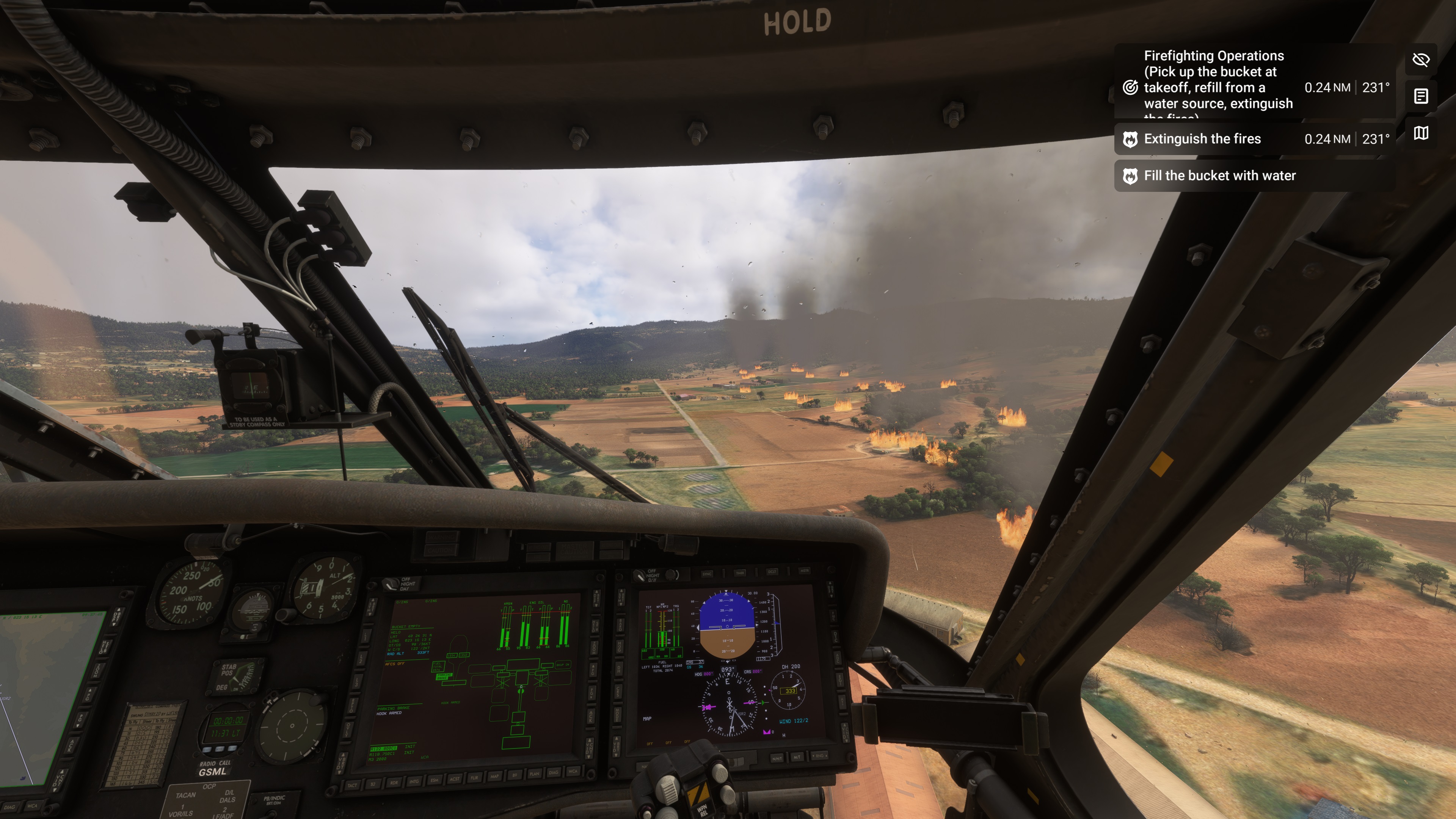
- Firefighting
- Maritime extraction
- Cargo transport
- Passenger and air taxi operations
- Sling-load missions
- Airdrops
- Roadside accident response
- Injured hiker rescues
- Surveillance
- Escort flights
- Aircraft interception
- Police pursuits
- Tactical and military-style operations
That range gives users a way to turn almost any aircraft into part of a structured mission.
A helicopter can become a rescue platform.
A bush plane can haul supplies into a remote strip.
A utility aircraft can work a firefighting operation.
And if you have ever looked at a police helicopter and thought, “Flight Simulator needs more car chases,” MissionGen apparently agrees.
Co-Op Missions Fill a Big MSFS Gap
One of the most unusual features is MissionGen’s co-op synchronization.
Microsoft Flight Simulator 2024’s native Career Mode does not currently support shared multiplayer objectives.
MissionGen does.
In supported mission types, all pilots in the session see the same objective state.
For example, if one pilot extinguishes part of a wildfire, that progress is reflected for the other pilots.
If a survivor is rescued from the water, the objective can count for the entire group.
The same synchronization is available for rescue, firefighting and sling-load missions.
That turns MSFS multiplayer into something much more structured than several airplanes simply occupying the same airspace.
It Works With Standard Multiplayer and VATSIM
The developer says co-op can operate using standard Microsoft Flight Simulator multiplayer as well as while users are flying on VATSIM.
There is one important requirement.
Everyone participating in the shared mission needs to own the Miltech Mission Hub.
The host generates the mission and shares a six-character code.
Other pilots use that code to retrieve the same mission, load it through Mission Hub and join the co-op session.
The process is designed to make it relatively quick to get several pilots into the same scenario without manually distributing mission files.
Real Wildfires From NASA Data
The feature that really separates MissionGen from a standard random-mission generator is its Live Firefighting mode.
MissionGen can use real-world active-fire data from NASA’s Fire Information for Resource Management System, better known as FIRMS, to determine where firefighting missions should appear.
That means the generated fires can be placed near locations where real wildfires have recently been detected.
The tool works from a cached version of that data rather than continuously pulling live satellite information during the flight, but it still gives generated missions a direct connection to real-world fire activity.
Instead of the generator deciding that a random forest outside Denver should be burning today, it can place the mission near an area where actual fire activity has been recorded.
That is a pretty clever way to give procedural missions some real-world context.
Firefighting Can Get Big
MissionGen’s firefighting scenarios can range from relatively small incidents to much larger fire lines.
The free version limits some of that scale, while the Pro version can create fire lines containing significantly more fire locations.
The MissionGen site also highlights large-scale aerial firefighting missions involving water drops, active burn zones and supply support for ground crews.
That should make it especially attractive to pilots using firefighting-capable aircraft or helicopters.
Campaigns Add Continuity
MissionGen is not limited to isolated missions.
It can also create campaigns where one mission leads into another.
The developer currently lists campaign types including:
- Rescue Pilot
- Caribbean Operations
- Ukraine Campaign
- Bush Pilot
- Firefighting Career
- Air Taxi
- Seaplane operations
- Freight Dawg cargo operations
These are designed to provide some continuity rather than having every flight exist in isolation.
That is especially interesting for users who enjoy Career Mode but want a more specialized experience.
Search and Rescue Goes Beyond a Waypoint
The search-and-rescue missions are designed around locating and extracting survivors rather than simply flying from Airport A to Airport B.
MissionGen can place rescues in rough terrain, coastal areas and maritime environments.
The MissionGen site describes scenarios involving SAR hoists, roadside accidents, coastal rescues and bad-weather extractions.
That makes helicopters an obvious fit, but the broader system also allows fixed-wing aircraft to take part in search, transport and support roles.
Maritime Missions Are Included Too
MissionGen can generate offshore rescue scenarios involving vessels in distress.
Those missions incorporate open-water pickups and operations where wind, timing and sea conditions become part of the challenge.
That adds another layer of variety for helicopter and seaplane pilots.
Instead of always heading toward an airport, the objective might be sitting somewhere in the ocean.
Preferably attached to something floating.
Military-Style Missions Are Part of the Mix
MissionGen also supports more tactical scenarios.
The developer lists military-style missions including:
- Recon flights
- Supply drops
- Insertions
- Extractions
- Drone hunting
- Conflict-zone operations
These are not intended to turn Microsoft Flight Simulator into a full combat simulator.
Instead, they use the mission framework to give military and utility aircraft structured objectives.
For users flying transports, helicopters or surveillance aircraft, that can create a very different experience from the standard civilian Career Mode.
Police Pursuits Come to Flight Simulator
Yes, really.
MissionGen can also create police pursuit missions.
That gives helicopter pilots a reason to orbit low over roads, track vehicles and follow moving objectives instead of endlessly practicing airport circuits.
It is one of those mission types that sounds slightly ridiculous until you remember how many people own detailed police helicopters, utility aircraft and rotorcraft setups.
Then it starts making a suspicious amount of sense.
The Free Version Is Actually Free
MissionGen itself is available in a free tier.
The basic generator can create missions without requiring a subscription, and co-op participation is currently free.
A Pro subscription unlocks the heavier features.
According to the developer, Pro currently costs:
- $2 per month
- $10 per year
Pro adds access to persistent campaigns, unlimited campaign starts, expanded mission history, mission sharing by code and more complex mission generation.
The free tier still provides enough functionality to try the system before paying.
You Still Need Miltech Mission Hub
MissionGen is not a standalone replacement for Miltech Mission Hub.
It generates the missions.
Mission Hub runs them inside Microsoft Flight Simulator 2024.
That means anyone interested in MissionGen will need the Miltech product as the underlying mission platform.
For multiplayer sessions, all participating pilots must also have Mission Hub installed.
Browser-Based With a Windows Companion
The main MissionGen interface runs in a web browser.
Users can choose a mission type, location and other parameters directly from the site, generate the scenario and then bring it into MSFS 2024.
A separate Windows companion application is used for hosting and joining synchronized co-op sessions.
That keeps most of the mission creation outside the simulator itself while still allowing the final mission to run through Mission Hub.
Giving Pilots a Reason to Fly
Mission generators are not glamorous in the same way as a new airliner or airport scenery package.
But they solve a different problem.
Microsoft Flight Simulator already gives users a planet, thousands of airports and an enormous collection of aircraft.
The harder question is sometimes:
What should I actually do with all of it?
MissionGen answers that by turning the world into a constantly changing collection of jobs.
One flight might involve pulling survivors from the ocean.
The next could involve dropping water on a real-world wildfire location.
Another might send a group of pilots hauling cargo into a remote strip.
And somewhere in the middle of all that, somebody is apparently chasing a car with a helicopter.
A Different Kind of MSFS Add-On
MissionGen is particularly interesting because it is not trying to improve how Microsoft Flight Simulator looks.
It is trying to change how people use it.
Dynamic generation means missions do not necessarily have to be handcrafted one at a time.
Co-op synchronization gives multiplayer pilots shared objectives.
Campaigns give those missions continuity.
And the integration of real NASA wildfire locations gives at least one part of the system a connection to events happening outside the simulator.
That combination could make MissionGen particularly appealing to pilots who enjoy helicopters, bush aircraft, firefighting, utility flying and other operations that do not always fit neatly into traditional airline-style simulation.
For years, flight simmers have accumulated increasingly detailed airplanes.
MissionGen is offering something different.
A reason to start the engine.