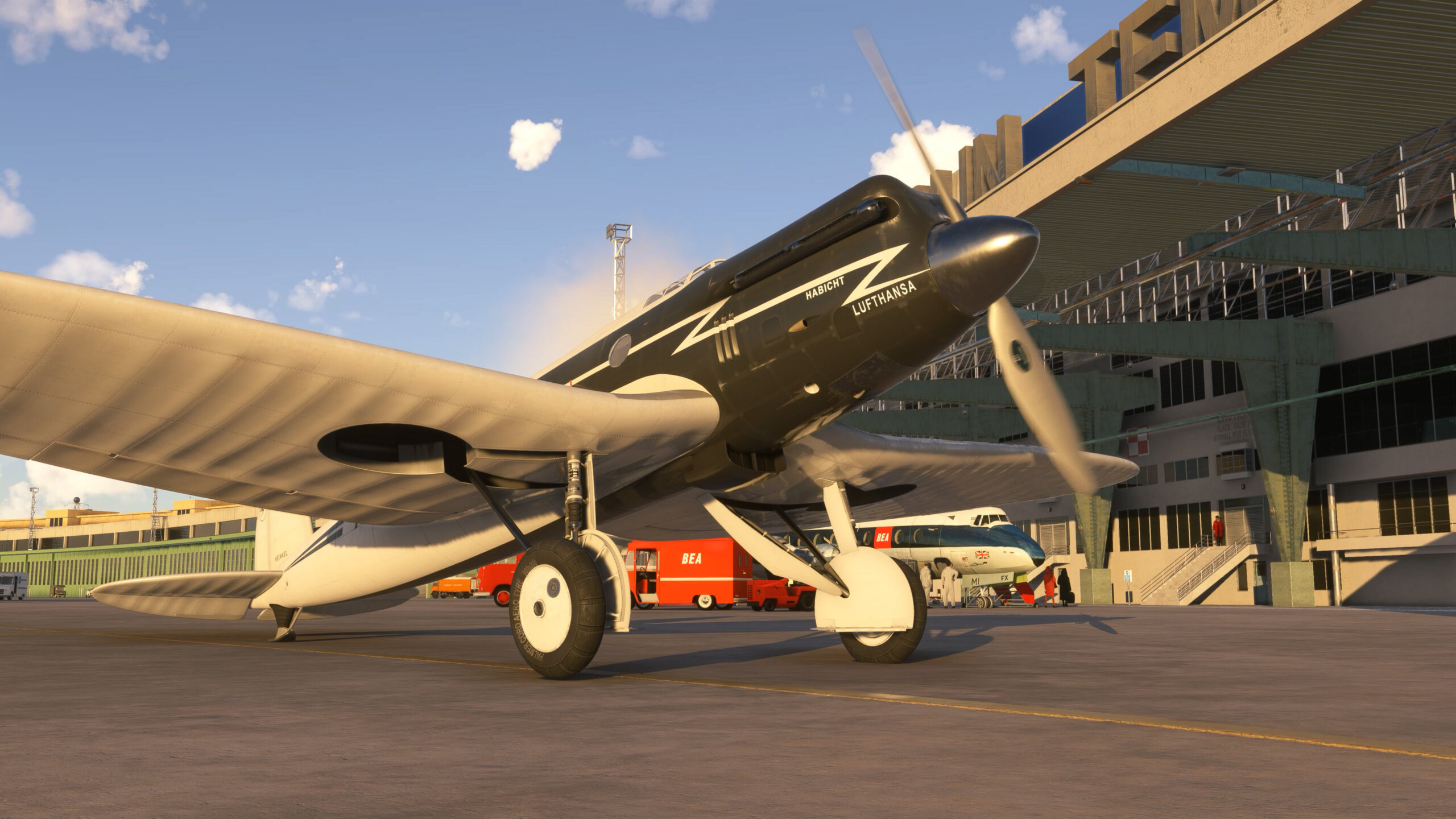

No complete Heinkel He 70 survives today, so the Microsoft Flight Simulator team and its development partners had to rely on extensive historical research, including contacting the U.S. National Archives to digitize original aircraft plans for the project.
That makes Local Legend 25 as much an exercise in aviation preservation as it is another Marketplace aircraft.
Rebuilding an Aircraft That No Longer Exists
Many modern flight-simulation projects begin with access to a real aircraft.
Developers photograph cockpits, scan fuselages, record engines and sometimes work directly with pilots or restoration teams.
That was not possible with the He 70.
Microsoft says most examples were destroyed during World War II, while the Spanish Air Force scrapped the final surviving airframes in 1954. With nothing left to scan, the team turned to surviving documentation and original engineering material to recreate the aircraft.
The U.S. National Archives became part of that process, digitizing original He 70 plans for the project.
For a simulator increasingly capable of preserving historic aircraft digitally, that is a fascinating use of the platform.
Built to Be the Fastest
The Heinkel He 70 began as a response to a commercial challenge.
In 1931, Deutsche Luft Hansa approached Heinkel Flugzeugwerke looking for an aircraft capable of providing exceptionally fast passenger and mail service across Europe.
The resulting design was a sleek, single-engine, low-wing monoplane centered heavily around aerodynamic efficiency.
Its most recognizable feature was the elliptical wing, combined with a streamlined monocoque fuselage and retractable landing gear.
Microsoft notes that the retractable undercarriage represented a first for German commercial aviation.
The aircraft first flew on December 1, 1932, before entering service in 1933.
Eight World Speed Records
The He 70 quickly proved that the beautiful shape was not merely decorative.
Microsoft says the first prototypes reached around 234 mph during testing, and the design ultimately established eight world speed records.
That performance earned the aircraft the nickname “Blitz,” German for lightning.
For the early 1930s, the numbers were remarkable.
The production aircraft cruised at approximately 183 mph and could reach around 220 mph, according to Microsoft’s historical overview.
It was powered by a single BMW VI V-12 piston engine, producing as much as 740 horsepower and driving a two-bladed metal propeller.
A Passenger Aircraft With Serious Style
The He 70 was originally conceived primarily as a high-speed passenger and mail aircraft.
It could accommodate up to six people including the pilot or pilots.
Deutsche Lufthansa used the type on domestic routes linking Berlin with cities including Frankfurt, Hamburg and Cologne.
The airline also operated it internationally between Stuttgart and Seville, Spain.
Compared with the boxier transport aircraft common during the period, the He 70 looked almost impossibly modern.
Its smooth fuselage, elliptical wing and retractable landing gear foreshadowed design trends that would soon become common on high-performance aircraft.
An Advanced Design for Its Time
Heinkel went to considerable lengths to reduce drag.
The He 70 used:
- A low-wing cantilever configuration
- Elliptical wings
- Trailing-edge flaps
- A monocoque fuselage
- Stressed metal skin
- Countersunk rivets
- Retractable landing gear
- A retractable radiator
That last feature is particularly interesting.
The BMW V-12 was liquid cooled, and the aircraft used a radiator that could be retracted to reduce aerodynamic drag when full cooling was not required.
It is exactly the kind of mechanical detail that makes early high-performance aircraft so interesting to simulate.
The He 70 Eventually Went to War
Like many fast civilian aircraft of the period, the He 70 eventually attracted military attention.
Germany’s Luftwaffe began using the aircraft in 1935, primarily for reconnaissance and intelligence missions, although it also served as a light bomber.
Several militarized versions were sent to Spain during the Spanish Civil War, where they were used largely for reconnaissance operations.
The aircraft therefore occupies an unusual place in aviation history.
It began life as a cutting-edge commercial transport, then transitioned into military service as Europe moved toward war.
More Than 300 Were Built
Despite its rarity today, the He 70 was not an obscure one-off prototype.
Heinkel produced 324 aircraft across more than a dozen variants, according to Microsoft.
The design remained in service for more than two decades.
Its importance also extended beyond the He 70 itself.
The He 70 Helped Shape the He 111
The He 70 became an important design foundation for the much larger Heinkel He 111.
Microsoft notes that the He 70 served as the basis for the later twin-engine aircraft, which began as an airliner before becoming one of Germany’s best-known bombers of World War II.
The family resemblance is not difficult to spot.
The elliptical wing and streamlined design philosophy carried forward into later Heinkel aircraft.
That gives the He 70 historical significance beyond its record-setting achievements.
It became part of the aerodynamic DNA of aircraft that followed.
A Rare Chance to Experience the Cockpit
The absence of surviving aircraft makes the MSFS recreation particularly interesting from an educational standpoint.
There is no restored He 70 sitting in a museum where visitors can walk around it.
There is no preserved cockpit available for enthusiasts to climb into.
And there is no airworthy example available for developers to record.
The virtual aircraft therefore becomes one of the few ways people can experience something resembling the original machine from the pilot’s perspective.
That is where flight simulation can quietly become more than entertainment.
It can preserve experiences that physical aviation history can no longer provide.
Historically Accurate Liveries
Microsoft says the aircraft ships with several historically accurate liveries, including examples officially licensed by Lufthansa.
That is particularly appropriate given the He 70’s beginnings as a high-speed commercial transport for Deutsche Luft Hansa.
Those airline schemes also help distinguish the aircraft from its later military career and reinforce its origins during the Golden Age of commercial aviation.
Performance That Still Sounds Fun Today
The He 70 may be more than 90 years old, but its performance numbers remain respectable for a single-engine piston aircraft.
Microsoft lists:
Length: 38 feet, 5 inches
Wingspan: 48 feet, 7 inches
Height: 10 feet, 2 inches
Engine: BMW VI V-12
Power: Up to 740 horsepower
Range: 1,130 miles
Service ceiling: 20,000 feet
Maximum climb: 1,320 feet per minute
Cruise speed: 183 mph
Top speed: 220 mph
Those figures help explain why the aircraft caused such a stir when it appeared.
At a time when aviation technology was advancing at breathtaking speed, the He 70 represented another leap forward.
Available for Both MSFS Generations
Local Legend 25 is available now through the in-sim Marketplace for both:
- Microsoft Flight Simulator 2020
- Microsoft Flight Simulator 2024
Microsoft has priced the Heinkel He 70 Blitz at $14.99 USD.
The aircraft was released on August 27, 2026.
Local Legends Continues Its Aviation Preservation Role
Microsoft’s Local Legends series has always focused on aircraft with strong connections to aviation history and particular regions of the world.
The He 70 takes that idea a little further.
This is not simply a historically significant airplane being reproduced for the simulator.
It is an aircraft that has completely disappeared from the physical world.
Recreating it required researchers to work backward from photographs, documentation and original technical plans.
There was no surviving airframe to measure.
No cockpit to photograph.
No engine to record.
Just history waiting to be reconstructed.
An Extinct Aircraft Flies Again
Flight simulation often chases the newest aircraft.
The newest avionics.
The newest airliner.
The newest technology.
The Heinkel He 70 is interesting for precisely the opposite reason.
It represents something aviation lost.
An aircraft that once set speed records, carried passengers across Europe and influenced a generation of designs eventually vanished entirely.
Now, more than 90 years after its first flight and more than 70 years after the last surviving examples were scrapped, the Blitz can fly again.
Not because someone restored one.
Because someone found the drawings.